Prepare with a free, 2025-ready SHL practice test—complete with sample questions, full answers, and realistic timing. Practise the SHL General Ability (Verify G+), Numerical, Verbal, Inductive, Deductive, Checking, and Mechanical tests so you know exactly what to expect on test day.

Hi, I’m Ira. I'm a trained clinical psychologist and a long-time expert in psychometric testing for JobTestPrep.
I help design simple and effective learning modules to help candidates succeed on career aptitude tests.
SHL isn’t a single exam—it’s a library of assessments that employers can mix and match. After choosing the assessment most relevant to them, they invite candidates using SHL's Talent Central platform.
The most common are cognitive ability tests. These are often administered alongside behavioural tests (like the Situational Judgement Test) and personality & motivation assessments (like the OPQ).

Increasingly, candidates are also being invited to take the Smart Interview On Demand (SHL's AI Interview).
Your email invitation will name the exact test (or tests) your employer has chosen—use the menu below to jump to the one you need.
Free SHL Practice Exams (With Tips)
Jump to:
Or navigate to out page about the SHL Verify G+ (General Ability)

SHL Numerical Reasoning Practice
Employers use the SHL numerical reasoning tests to measure how confidently you work with numbers in real work situations.
There are several versions – including SHL Verify Interactive Numerical Reasoning, Verify Numerical Reasoning, Verify Numerical Ability, and other SHL calculation and graduate-level tests.
Although each test looks slightly different, they all assess your ability to quickly interpret data, compare figures, and perform accurate calculations under strict time limits.
In the practice questions below, you’ll see two common SHL numerical formats: column charts and pie charts. On the actual SHL numerical tests, you may also face line graphs, number ranges, and ranking tasks, with questions ranging from relatively simple to quite challenging and multi-step.
Question 1 – Column Chart
Economist A's budget is 1,000 pounds. Economist A invested 20 pounds more in stocks than economist C.
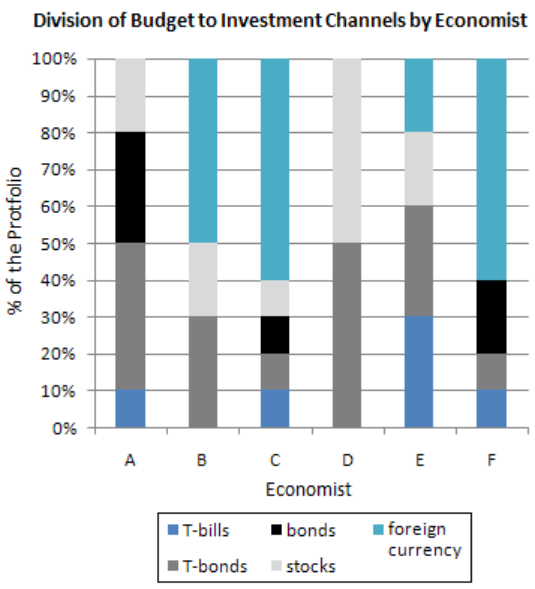
What was Economist C's Budget?
Shortcut
The percentage formula is (part ÷ whole) × 100.
However, on a timed test like this, you may want to take a shortcut. Remember that to calculate 10% of anything, you need only move the decimal one spot to the left.
This way, 1,000 becomes 100.0.
If your percentage is a multiple of 10, multiply it to get your answer. So, 20% is 10% times two: 100 × 2 = 200. You can do this backwards as well: If 10% of a whole is 180.0, find the whole by moving the decimal one spot to the right: 1,800.
Question 2 – Column Chart
Observe this table of monthly costs for mobile packages:
| Mobile Company | TeleP | Mobility | XR-Communication | WiF | Call.org | Red | |
|---|---|---|---|---|---|---|---|
|
Package name (€ per month) |
Basic | €6.0 | €5.8 | €4.0 | €2.9 | €6.7 | €7.2 |
| Coach | €6.5 | €6.0 | €5.0 | €3.9 | €6.5 | €7.4 | |
| Business | €7.0 | €7.1 | €5.1 | €4.9 | €6.9 | €7.5 | |
| first Class | €7.1 | €7.5 | €5.2 | €5.9 | €7.4 | €7.6 | |
| Supreme | €8.0 | €7.9 | €5.3 | €6.0 | €8.0 | €737 | |
| Contract Length (Months) | 24 mon | 12 mon | 18 mon | 12 mon | 6 mon | 24mon | |
| Total No. of Sales | 7,000 | 9,250 | 6,900 | 11,550 | 5,000 | 4,800 | |
* Sales are distributed equally across the five different packages
Which Company has the highest monthly turnover?
Shortcut
You can save time by using estimations to eliminate some answer options. To maximise turnover, you can eliminate companies with low sales and low prices. Call.org and Red have relatively few sales (about 1⁄3 to ½ of WiF’s sales).
Though their prices are higher than those of WiF, you can see that it is not enough to make up for the significant difference in sales (to make up for it, their prices should have been 2-3 times higher than those of WiF).
Hence, you can eliminate Call.org and Red without performing any calculation.
Use our pop-up sample test to get a feel for what the real SHL Numerical Reasoning is like.
After you complete this short numerical mini-test, we’ll move on to the SHL Deductive Reasoning section, which focuses more on logical thinking, attention to detail, and drawing conclusions from the information given.

SHL Deductive Reasoning Practice
Deductive reasoning is the ability to consider general "rules" and apply them to specific situations. You can view it as thinking "from the top down" - from rules to conclusions.
Let's take a look at two deductive question types that SHL test-takers typically find challenging: ordering and calendar.
Both these question types are meant to simulate real office situations.
Question 1 - Ordering
The following employees work in the same office. Here are some statements about their order of arrival to work this morning:
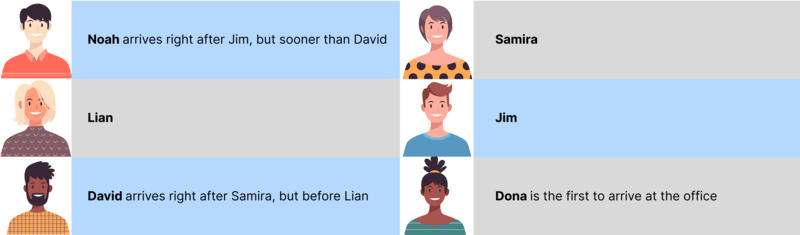
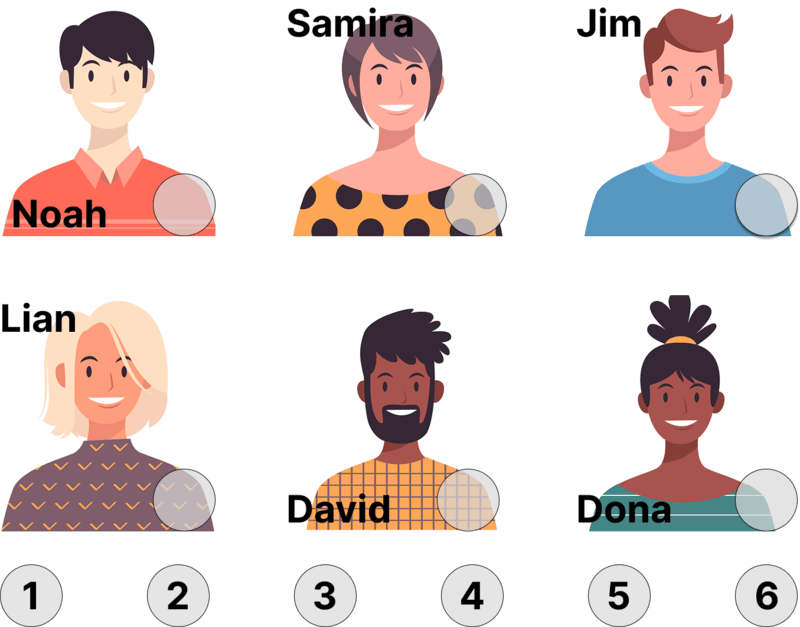
Mark the correct badge for each employee, sorting them in their order of arrival at the office, from 1 (first to arrive) to 6 (last to arrive).
Let’s break down the statements step by step:
- Start with the fixed-order statements:
Dona is the first to arrive at the office. - Second, combine statements that relate to each other:
David arrives right after Samira but before Lian. Therefore, address Samira, David, and Lian as one unit:
Samira -> David -> Lian
Noah arrives right after Jim, but sooner than David:
Jim -> Noah
Since Samira, David, and Lian act as one unit (they arrive right after the other), then if Noah arrives sooner than David, he arrives sooner than Samira as well:
Jim -> Noah arrive earlier than Samira -> David -> Lian
Note that Jim and Noah also act as one unit.
Adding Dona to the list:
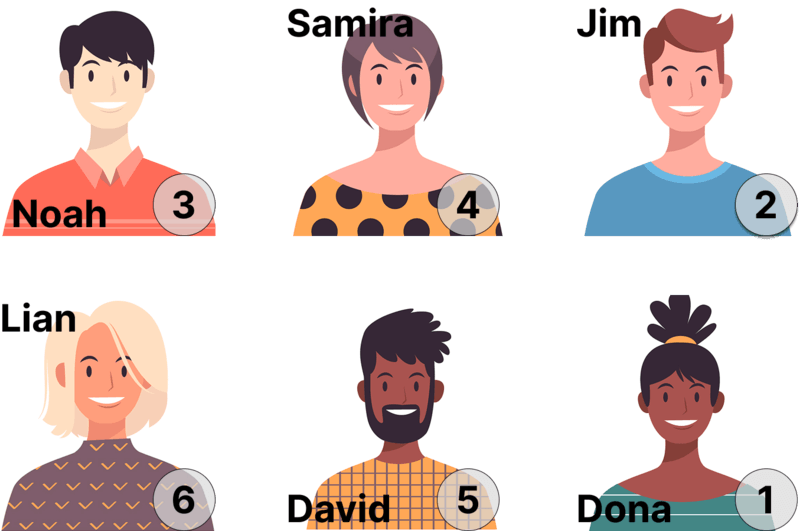
Dona - Jim -> Noah - Samira -> David -> Lian
Since David arrives before Lian (even if it doesn't say "right before"), you can conclude that Lian is the last to arrive at the office. There is no other order that fits with all the statements.
| Dona | Jim | Noah | Samira | David | Lian |
| 1 | 2 | 3 | 4 | 5 | 6 |
Question 2 - Calendar
A team of employees is trying to schedule a day trip together the following month.
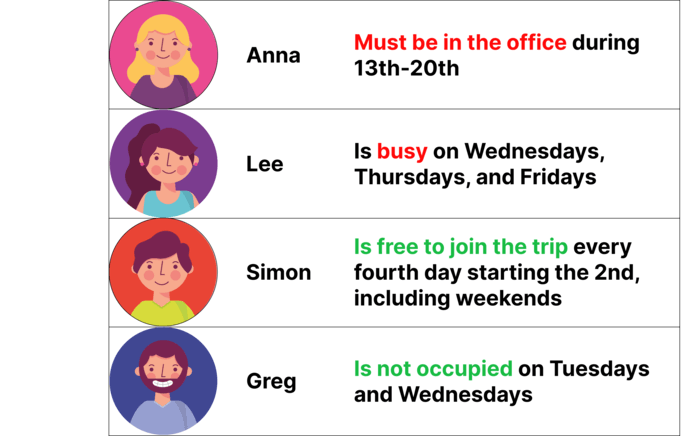
Select all possible weekdays next month when all team members can join the trip.
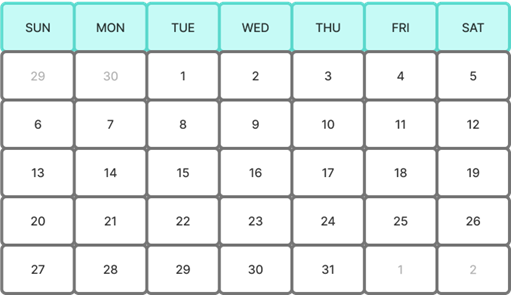
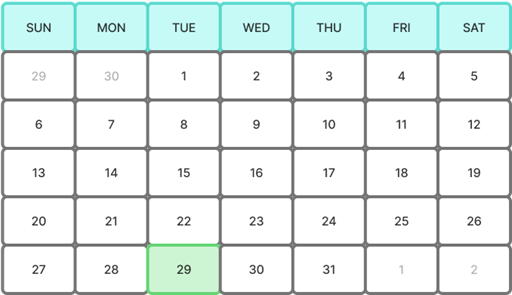
The (only) correct answer is the 29th of the month:
Let’s break down the statements step by step:
- Turn general negative statements into positive phrasing:
Lee: is available on Mondays and Tuesdays.
Together with the statement we already have:
Greg: is available on Tuesdays and Wednesdays.
There is only one weekday that is overlapping for Greg and Lee –Tuesday. - Extract relevant information from other statements:
Simon is free every fourth day, starting the 2nd. Counting every 4th day (2-3-4-5., 6-7-8-9, ….), the only Tuesday available is the 29th.
Anna will not be available between the 13th-20th. This period includes one Tuesday (the 15th) which doesn’t overlap with Simon’s only free Tuesday. - Choose the dates:
The only date all team members could go on a day trip is the 29th.
Tip
The examples you’ve just seen are typical SHL Deductive Reasoning questions, based on calendars, schedules, and ordering information. In the real SHL deductive test (both interactive and non-interactive), you’ll need to apply rules and constraints, combine several pieces of information, and spot contradictions to reach a single correct conclusion – all under strict time limits.
SHL uses deductive reasoning both as part of the Verify G / Verify G+ general ability test and, in some cases, as a stand-alone SHL deductive reasoning assessment.
In the next section, we’ll move on to the SHL Inductive Reasoning test, which also relies on logical thinking but focuses on recognising patterns in abstract shapes and diagrams rather than working with written information and schedules.

SHL Inductive Reasoning Practice
If deductive reasoning is defined as applying rules to specific instances, inductive reasoning is the opposite: examining particular patterns and identifying the laws that govern them.
Let's solve two SHL Inductive Reasoning questions, alphanumeric sequences and next-in-series:
Inductive Question #1 - Alphanumeric Sequences
Observe the following sequence

Keep drawing lines between the octagons until they are all connected according to the same pattern.
The complete sequence is:

The question asks you to find the logical rules applied between these nodes and complete the sequence, which started with the connected nodes: AZ -> 19 -> BY -> 28.
Logical Rule #1: The sequence starts with a node containing letters, which connects to a node containing numbers, which then connects once again to a node containing letters. The final sequence will stick to this pattern: Letters -> Numbers -> Letters -> Numbers, and so forth.
Logical Rule #2: The main “theme” of this question is opposite extremes:
• A and Z are the first and last letters of the alphabet.
• 1 and 9 are the first and last digits in the base-10 system (excluding 0 which does not appear in the question).
With each connection, these letters and digits are ‘getting closer’ to each other:
• B and Y – are the second and the second-to-last letters of the alphabet.
• 2 and 8 – are the second and second-to-last digits (presented in this question).
Following these rules, the next nodes should be the third and fourth letters or digits.
Final answer: AZ -> 19 -> BY -> 28 -> CX -> 37 -> DW -> 46 -> EV -> 55
Inductive Question #2
Observe the following series:

Fill in the colours of the hexagram to create the next figure in the series.

Tip
The examples you’ve just seen are typical SHL Inductive Reasoning questions, where you spot patterns in shapes, sequences, and symbols to decide what comes next. In the real SHL inductive test, you’ll answer similar questions under tight time limits (often about a minute per question), so both speed and accuracy matter.
On the interactive versions (like SHL Verify G+), you may also need to move or arrange items on the screen, not just pick an answer, which makes practising SHL-style inductive questions especially important.
The SHL Verify G (also known as the SHL Verify G+ or SHL general ability test) is an online aptitude test that measures your overall reasoning ability. It includes numerical, inductive, and deductive questions like the ones we've covered so far.
Employers use it for many graduate, professional, and managerial roles.
The test comes in one of two versions:
- Interactive (Verify G+ / interactive) – you answer questions in a more dynamic way, for example, by clicking and dragging, ranking items, or adjusting values on charts and number lines.
- Non-interactive (traditional, multiple-choice) – you choose your answer from a fixed list of options.
Both interactive and non-interactive SHL tests assess the same core abilities: numerical reasoning, deductive (logical) reasoning, and inductive (abstract) reasoning.

SHL Verbal Reasoning Practice
SHL’s verbal tests measure how well you understand written information and use it to make correct decisions.
- The SHL Verify Verbal Reasoning test focuses on short passages where you decide whether statements are true, false, or "cannot say", based only on the text.
- The SHL Reading Comprehension test uses slightly longer texts and multiple-choice questions, asking you to identify the main point, key details, or correct conclusion – all under strict time limits.
Let's look at examples:
Simulate the real SHL Verbal Exams with our free pop-up test.

SHL Checking Reasoning Practice
The SHL Checking assessment is designed to screen candidates for clerical positions.
As such, the measure attention to detail, response times, and level-headedness during stressful tasks that require focus.
Tip
The SHL Checking section includes a very straightforward type of question. However, questions may become increasingly longer and with less time to answer as the tests progress. Comprehensive practice, including increasing difficulty, can be found in our All-inclusive SHL Preparation Pack.

SHL Mechanical Comprehension Practice
Although SHL is often associated with companies in the finance and business sectors, such as Capitec Bank, Barclays, Agoda, and Vodafone, it also serves companies looking to hire for more hands-on positions: maintenance techs, electricians, and engineers.
The SHL Mechanical Comprehension Assessment is designed to measure candidates' basic intuition about mechanical principles like leverage, torque, current, resistance, and fluid mechanics. It also ascertains candidates' familiarity with tools of the trade and what jobs they perform.
Let's view some examples:
Mechanical Question #1
When the rod is spun (following the black arrow),

Which direction will the light blue wheel spin?
Answer & Explanation
The correct answer is (b).
We will mark the wheels as 1,2,3 and 4. See the picture below.
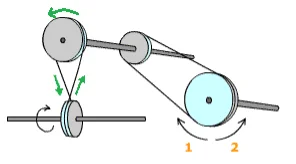
Wheel 1 rotates clockwise, thus moving the band in the direction shown by the green arrows. That movement will, in turn, rotate wheel 2 anticlockwise.
Since wheels 2 and 3 are connected by a band, wheel 3 will also rotate anticlockwise.
Since wheels 3 and 4 are connected by a band, wheel 3 will also rotate anticlockwise.
Mechanical Question #2
What would the total resistance be if a resistor was added in parallel to the following circuit?

a. 3R
b. 2R/3
c. 3R/2
d. Remain the same
Answer & Explanation
The correct answer is (b).
We shall use this question as a pretence to clarify how total resistance is calculated in general.
Series Connection:
Resistors are said to be connected in series if the currents through each of the resistors are equal. For example, the same current must flow through the two resistors in the middle of the figure.
If resistors R1, R2, ..., Rn are connected in series, then their total resistance Rt can be calculated using the formula
Rt = R1 + R2 + ... + Rn
This means we can replace the resistors with a single resistor with resistance Rt and the rest of the circuit will not be affected.
In this case, we can replace the two resistors in the middle with Rs = R + R = 2R.
Parallel Connection:
Resistors are said to be connected in parallel if the voltages across each of the resistors are equal. For example, after connecting the resistors in the middle in series, there must be the same voltage across the resistor on the right and the new resistor Rs in the middle.
If resistors R1, R2, ..., Rn are connected in parallel, then their total resistance Rt can be calculated using the formula
1/Rt = 1/R1 + 1/R2 + ... + 1/Rn
Again, we can replace the resistors with a single resistor with resistance Rt and the rest of the circuit will not be affected.
In this case, we can replace the two resistors in the middle with
1/Rt = 1/Rs + 1/R = 1/2R + 1/R = 3/2R
Rt = 2/3R.
💡 Solving Tip: The formulas show that adding a resistor in series will always increase the total resistance, while adding one in parallel (as suggested here) will always decrease the total resistance.

SHL Personality Assessments - the OPQ and MQ
SHL has gained world renown for its thoroughly researched and validated behavioural assessments.
Particularly, the Occupational Personality Questionnaire, or SHL OPQ, is among the most common theoretical models for assessing someone's behaviour at work and job fit. It's based on ranking the candidate on a set of 32 different traits.
The SHL Motivation Questionnaire focuses on candidates' unique motivators to inform employers on how to encourage engaged workers and make promotion decisions.
Let's look at OPQ sample questions:
JobTestPrep's SHL Prep Pack
Like all pre-employment exams, SHL can be a bothersome and scary hurdle on the way to your career goals.
JobTestPrep has over 30 years of experience guiding job candidates towards psychometric success, and our SHL courses have been particularly successful.
Over 15,000 candidates since 2023 alone have used our comprehensive practice tests, complete with full and detailed solutions, to pass the SHL exams with ease.
What Our Learners Have Said:
Start Practicing Today!