 Talogy's Caliper Test PrepPack (2026)
The Caliper assessment is a pre-employment psychometric test developed by Talogy, designed to predict workplace performance by measuring how a candidate's personality traits and cognitive ability align with the behavioural demands of a specific role. Though the test doesn't focus on right-or-wrong answers, its position as a job-fit evaluation tool and combination of personality and cognitive assessments means preparation is key.
Our comprehensive PrepPack combines full-length simulations, feedback reports, position-specific personality practice, and cognitive prep materials so you can present your strengths clearly and authentically.
Caliper Profile Test Prep
 1-MonthAccess
 Realistic practice tests & study guides
 Created by experts with a focus on accuracy
What's Included:
- 2 Full-Length Simulations
- 18 Position-Specific Practice Tests
- 6 Position-Specific Study Guides
- 47 Cognitive Preparation Tests

Inside Our Caliper PrepPack
Our Caliper Assessment PrepPack is structured to mirror the real test and provides complete coverage of both the personality and cognitive components of the assessment.
- 1 Full Section A & B Forced-Choice Test Simulation: One complete Block A & B simulation to replicate the full forced-choice personality format.
- 12 Position-Specific Section A & B Practice Tests: 6 Section A and 6 Section B practice tests to reinforce behavioural consistency.
- 6 Position-Specific Personality Study Guides: Six Block A & B guides tailored to key roles, showing how the personality 21 traits combine into competencies and how job models prioritise behavioural patterns.
- 47 Cognitive Preparation Tests: Comprehensive coverage of every abstract reasoning format tested in the Caliper assessment, including 2 full figural analogies tests & 4 practice drills, 2 full figural series tests & 14 drills, 4 full figural matrices tests & 9 practice drills, 3 full number series tests & 9 drills, designed to sharpen pattern recognition, analytical reasoning, sequential thinking, and numerical problem-solving.
- 1 Full-Length Rating Test Simulation: One complete Rating Scale section practice test to mirror the style and length of the actual Caliper assessment’s rating questions.
- 6 Position-Specific Rating Scale Practice Tests: 6 additional Rating Scale section tests tailored to specific job roles.
This PrepPack provides structured personality preparation, full-length simulations with feedback, and complete cognitive practice coverage across all tested question types.

Full Simulations

Practice Tests

Study Guides
Get The Right Caliper Fit
Practise consistency in your personality profiles with our full-length simulations, targeted practice, and expert study guides.
What Is The Caliper Assessment?
Unlike traditional aptitude tests, the Caliper assessment is positioned as a job-fit evaluation tool that analyses how your motivations, interpersonal tendencies, decision-making style, and problem-solving approaches compare to high performers in the same type of job.
The Caliper test contains approximately 98 multiple-choice questions and is untimed, though most candidates complete it in 60 - 75 minutes. It's divided into 4 main sections, including 2 forced-choice personality sections ("Most & Least"), one rating-scale personality section, and one cognitive (abstract reasoning) section.
Each section serves a distinct purpose in building your overall behavioural profile.
What Is The Caliper Personality Forced-Choice Section?
The Caliper personality assessment starts with two forced-choice “Most & Least” blocks, designed to show your natural workplace behaviours and motivations.
In each block, you'll see groups of four statements and must choose the one that is most like you and the one that is least like you.
- Block A: The first section introduces the first set of traits, measuring core workplace behaviours like motivational drivers, interpersonal orientation, achievement style, dominance vs. cooperation, and structure vs. flexibility
- Block B: The second section may at first seem repetitive but presents different trait combinations and increases scoring accuracy by reassessing traits in varied contexts, testing behavioural stability, and strengthening reliability calculations
You cannot skip items or rate all statements equally, which ensures your true tendencies are measured.
The forced-choice format also reduces the ability to give socially desirable answers since you must trade off one positive quality against another. Consistency across repeated trait pairings is critical as the test checks for contradictions.
Employers use both blocks to see how well your behavioural patterns match the role, and consistent, role-relevant responses help strengthen your job-fit score.
This is what the Caliper Forced-Choice questions generally look like:
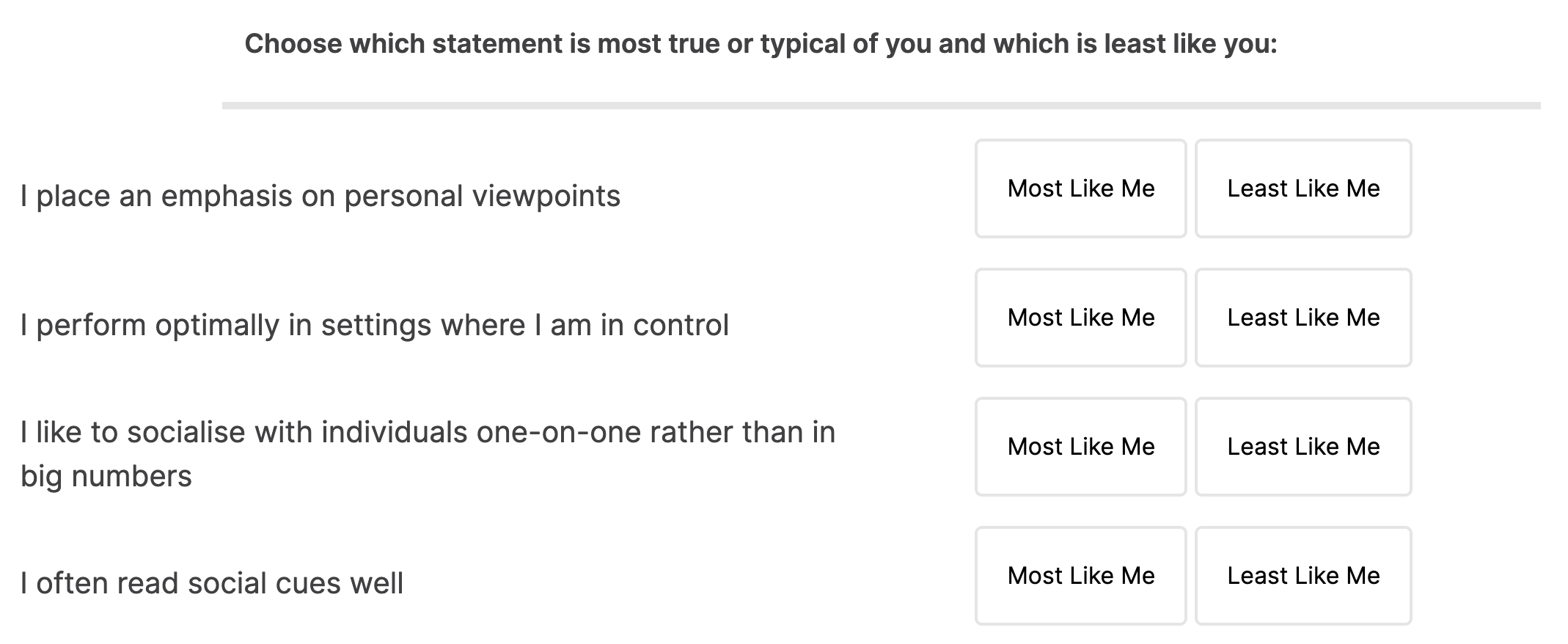
⭐️ Golden Tip: The Caliper Forced-Choice sections require you to prioritise one positive trait over another, so clarity and consistency are essential. Our Caliper PrepPack guides you through how workplace traits are evaluated, helping you align your responses with the behavioural patterns most valued in your target role, so you can answer confidently without second-guessing.
What Is The Caliper Personality Rating Section?
The next part of the Caliper personality assessment is the rating scale section, sometimes called agreement questions.
Here, you're presented with single behavioural statements and asked to rate your level of agreement, typically on a scale from strongly agree to strongly disagree.
Unlike the forced-choice blocks, this section measures traits such as emotional regulation, stress tolerance, confidence, skepticism, adaptability, and work pace. It provides additional insight into your behavioural intensity, self-perception, and response patterns, helping to balance the forced-choice data.
Overly extreme or contradictory answers can flag inconsistencies, so consistent, reflective responses are key to producing a reliable Caliper personality profile.
This is what the Caliper Rating Scale questions generally look like:

⭐️ Golden Tip: The Caliper Rating Scale section uses a seven-point Likert format, asking you to rate how strongly you agree or disagree with each statement. Our Caliper PrepPack helps you understand how these responses reveal workplace traits, so you can answer consistently and accurately to produce a reliable, role-aligned personality profile.
What Is The Caliper Cognitive Abstract Reasoning Section?
Although the Caliper Assessment focuses mainly on personality, it also includes a cognitive section to measure abstract reasoning and problem-solving ability.
This section typically contains around 11 questions designed to evaluate logical thinking, pattern recognition, and numerical reasoning.
Question types you may encounter:
- Visual analogies: Identify the relationship between two shapes and apply the same transformation to a third shape.
- Shape matrices: Determine the rule governing a matrix of shapes and select the correct missing cell.
- Shape series: Recognise the progression pattern in a sequence of shapes and select the next logical shape.
- Number series: Identify the mathematical rule in a sequence of numbers and determine the next number.
Success in the cognitive section requires careful observation, logical reasoning, and consistent problem-solving strategies.
There are different types of Caliper cognitive assessment questions, but this is a figural analogies example:
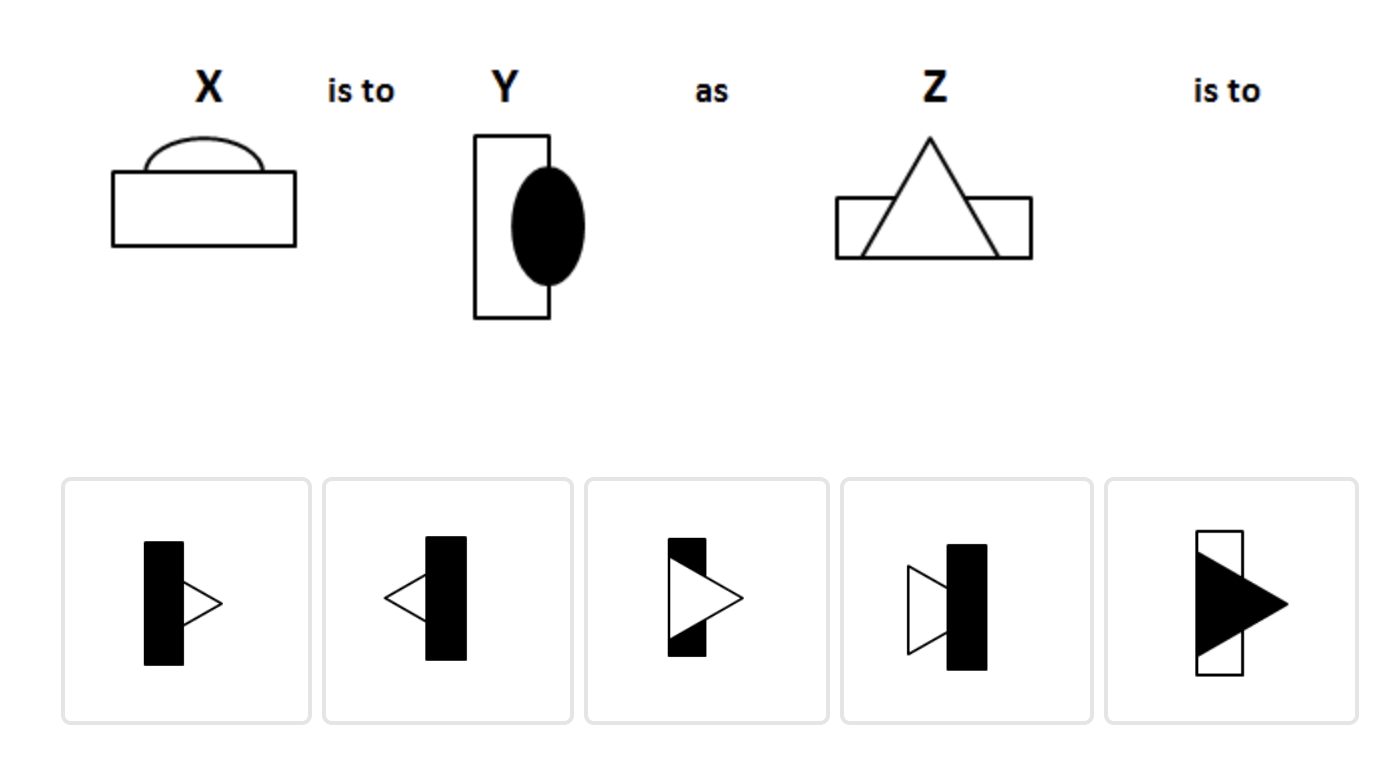
⭐️ Golden Tip: The cognitive section of the Caliper assessment tests your ability to recognise patterns, solve sequences, and analyse complex relationships. Our PrepPack gives you targeted practice across all question types, helping you build speed, accuracy, and confidence so you can tackle every abstract reasoning challenge with ease.
Employers primarily use the Caliper profile to improve hiring accuracy, reduce turnover risk, identify leadership potential, support structured interviewing, and benchmark candidates against role-specific competencies.
Grab Your Caliper PrepPack
To get more practice for your Caliper assessment and understand the key personality traits and workplace competencies, grab our complete Caliper PrepPack today.
The Caliper Framework: What The Test Measures & How It's Scored
The Caliper test is not a simple personality questionnaire or cognitive reasoning tool. It's a behavioural prediction system designed to estimate how you're likely to perform in a specific role.
As its core, the assessment measures three interconnected layers:
- Personality traits (raw behavioural drivers)
- Workplace competencies (applied behavioural patterns)
- Job-fit alignment (match to a specific role model)
Understanding how these layers connect is essential to understanding how the test works and gives key insight into the multi-layered scoring system. The scoring process moves from raw behavioural trait to job-specific performance alignment in the same three core stages.
The Caliper Competency Report
After you complete the Caliper assessment, the employer receives a detailed competency report designed to predict job performance, highlight behavioural strengths and risks, and guide structured hiring decisions.
This report translates your personality trait scores and competency alignment into practical, job-specific insights used during candidate evaluation and interviews.
- Job fit, competency overview & key findings: This section outlines your predicted potential to succeed in the role, expressed as a percentage or percentile alignment score based on the employer’s job model. It also summarises your key competencies by importance and highlights the behavioural strengths and potential risk factors most likely to influence your performance in the position.
- Interview questions & manager recommendations: This section includes structured, competency-based interview questions tailored to your profile to explore flagged development areas and validate behavioural patterns through real-world examples. It also provides targeted guidance for hiring managers on how to coach, motivate, and manage you effectively based on your work style and behavioural tendencies.
- Competency drill-down: A detailed percentile display of your competency scores relative to the job model benchmark, including behavioural descriptions of strengths and potential performance challenges.
- Work style preferences: An analysis of your workplace motivations, communication style, decision-making approach, collaboration tendencies, problem-solving orientation, and task management preferences.
- Trait graph: A visual graph of all 21 personality traits, showing your percentile score on each trait compared to the relevant professional norm group.
Together, these sections provide employers with a structured behavioural profile that influences hiring decisions, interview direction, onboarding strategy, and even long-term talent development planning.
Caliper Test Tips
Success on the Caliper assessment depends on demonstrating clear, consistent workplace behaviours rather than trying to memorise “right” answers. To perform at your best, focus on aligning your responses with the demands of the role while preparing strategically for both the personality and cognitive sections.
Key strategies include:
- Understand the role: Tailor responses to the decision-making style, independence, risk tolerance, and structure required for the position.
- Prioritise professional behaviour: Answer as you behave at work, not in social settings.
- Maintain consistency: Ensure your trait responses are coherent across different sections of the assessment.
- Prepare for cognitive questions: Practise pattern recognition, sequential reasoning, and rule detection to improve speed and accuracy.
- Avoid extreme impression management: Overly idealised or exaggerated answers can reduce reliability, so you should aim for authentic alignment with the role.
Our Caliper PrepPack provides realistic simulations, targeted personality practice, and extensive cognitive drills, giving you the tools to build confidence, strengthen consistency, and maximise your job-fit alignment before test day.
Master Your Caliper Test
Get everything you need to succeed, including full-length Caliper simulations, targeted practice exercises, and in-depth study guides.
Get your Caliper PrepPack now and start practising like a workplace performance pro!

FAQs
The Caliper assessment is untimed and you can pause and resume as needed. Most candidates complete it in around 60 - 75 minutes, though the duration can vary depending on individual pace.
A score of 60 or above generally indicates strong alignment with the role’s job model and suggests a high likelihood of success in the position.
There is no traditional pass or fail. The test measures behavioural tendencies to see how well they match the requirements of the role, rather than providing right or wrong answers.
Your results are sent directly to the employer. Sharing detailed feedback with candidates is at the company’s discretion.
Global companies across finance, healthcare, retail, and public sectors use the Caliper assessment to evaluate behavioural alignment and predict job performance.
Many candidates find the test challenging because it combines abstract reasoning and behavioural questions. The cognitive section can be particularly challenging if approaching the test unprepared.
All questions must be answered for the test to be scored. You can move around within sections but cannot leave any answers blank.
The assessment identifies your work-related competencies and behavioural tendencies, showing how likely you are to succeed in specific aspects of a role.
Keep in mind that you will not receive the results of your Caliper assessment, and you will only be notified if you have moved on to the next step of the hiring process. If you don't move on, it's because your personality may not be a good match for the specific position, but it does not pass any judgement on your personality, intelligence, or skills more generally.
Preparing for the Caliper assessment helps improve clarity, consistency, and confidence. Practising cognitive exercises, reviewing sample personality questions, and reflecting on your workplace behaviours can increase alignment with the job model and improve overall performance.
The Caliper PrepPack provides full-length personality and cognitive simulations, position-specific practice, targeted drills, and detailed feedback reports. Using the PrepPack helps you familiarise yourself with the test format, understand the competencies being assessed, and strengthen your readiness for test day.
Who Are We?
At JobTestPrep, we’ve supported thousands of candidates in succeeding at highly competitive recruitment assessments, including those used by leading consulting firms. Our resources are developed by psychometric experts and continuously updated to match the latest test formats, ensuring you prepare with materials that reflect the real assessment.
Established in 1992 by David Meshulam, JobTestPrep is a trusted leader in online test preparation. With over 30 years of experience, 220+ preparation packs, and more than a million success stories worldwide, we combine expertly developed practice materials with advanced AI tools, including our CV Analyser and Interview Prep platform, to help candidates across the UK and beyond achieve outstanding results with confidence.


More On Talogy & Cubiks
Explore more personality assessments on JobTestPrep:
16 Personalities | Adept 15 by AON (cut-e) | Alva Labs Test | Hogan Personality Inventory | Korn Ferry Leadership Tests (KFALP and KF4D) | McQuaig Word Survey | Myers Briggs (MBTI) | NEO Personality Inventory | PerformanSe | Predictive Index (PI) | Revelian Personality Tests | Saville Wave Personality Test | SHL Occupational Personality Questionnaire | Thomas HPTI | Thomas International PPA


