 British Army Cognitive Test (ACT) Practice (2026)
Last updated: 3 September 2026 | Trusted by thousands worldwide.
The Army Cognitive Test (ACT) is a fast-paced aptitude assessment used by the British Army to measure problem-solving ability, reasoning skills, and information processing speed. With around 200 questions to complete in just 45 minutes, the test is genuinely challenging, and preparation makes a real difference to your score.
Our British Army Cognitive Test PrepPack gives you 600+ practice questions across realistic ACT tests, targeted drills, and in-depth study guides covering every section of the assessment, helping you approach test day with a clear head and a plan.
Army Cognitive Test
 1-MonthAccess
 Realistic practice tests & study guides
 Created by experts with a focus on accuracy
What's Included:
- 600+ ACT-Style Practice Questions
- 8 Full-Length ACT Practice Tests
- 7 Targeted Section-Specific Skill-Building Drills
- 5 In-Depth Study Guides

Inside Our ACT PrepPack
Our Army Cognitive Test practice pack gives you over 600 questions covering every section of the ACT, built to sharpen your accuracy without losing pace under strict time limits.
- 8 Full-Length Practice Tests: Realistic ACT-style tests across all core sections, including 2 Error Detection tests, 2 Deductive Reasoning tests, 2 Number Fluency tests, 1 Word Rules test, and 1 Orientation test, allowing you to practise under conditions similar to the real assessment.
- 7 Section-Specific Targeted Skill Drills: Focused exercises to strengthen key abilities and improve speed in specific areas, including 3 Error Detection, 3 Deductive Reasoning, and 1 Number Fluency drill.
- 5 Comprehensive Study Guides: Clear explanations and strategies for every ACT section, covering question formats and the most efficient solving methods.
You'll get to work on all five sections of the Army Cognitive Test.
Boost Your ACT Scores
600+ practice questions across expert-created tests, targeted drills, and study guides, built around all five ACT sections.
What Is The British Army Cognitive Test?
The Army Cognitive Test (ACT) is a computer-based aptitude assessment that evaluates your potential for different soldier roles in the British Army. On the official Army recruitment site, it's sometimes listed under the broader category of Ability Tests.
Previously known as the BARB test (British Army Recruit Battery), it measures how quickly and accurately you can process information and solve problems under pressure.
You'll usually first come across the ACT as the Army Cognitive Test screener, sent to you online early in your application. Unlike the old BARB test, which was completed in person at your careers office, most candidates now sit the ACT remotely, from home, on their own device.
Your ACT performance directly influences which roles you're eligible for - the higher your score, the more career options are available to you. It's therefore one of the most important stages of the British Army recruitment process.
The Army ACT test lasts 45 minutes and consists of around 200 multiple-choice questions across five timed sections, each containing 30 - 60 questions.
The five ACT sections assess a range of cognitive skills:
- Orientation (assesses memory and spatial awareness)
- Error Detection (measures attention to detail)
- Number Fluency (evaluates mental arithmetic and numerical memory)
- Word Rules (tests memory and pattern recognition)
- Deductive Reasoning (assesses logical thinking and problem-solving)
With just 10 seconds per question on average, strong time management and quick thinking are essential.
Let's take a closer look at the different sections and some British Army Cognitive Test practice questions:
What Is The ACT Orientation Test?
The Orientation section of the Army Cognitive Test assesses your spatial awareness and memory, two abilities fundamental to a wide range of Army roles.
You'll have 5 minutes for approximately 30 questions.
Each question is presented in two stages:
- Stage 1: You're shown two rules describing the colour and direction of a pair of arrows. For example, "Black ABOVE White" or "Up Left BELOW Down Right." You must read and memorise both rules before proceeding. Once you click to continue, the rules disappear and cannot be revisited.
- Stage 2: Six sets of arrows are displayed and you must select the set that correctly follows both rules from memory.
Your score is based on both accuracy and speed - the faster you answer correctly, the higher your score. The real skill here is absorbing and holding onto spatial rules quickly, then applying them accurately once the clock's already running.
Have a go at a British Army Orientation test sample question:
Remember this: Down Left White
Then, choose the image that best matches the statement.
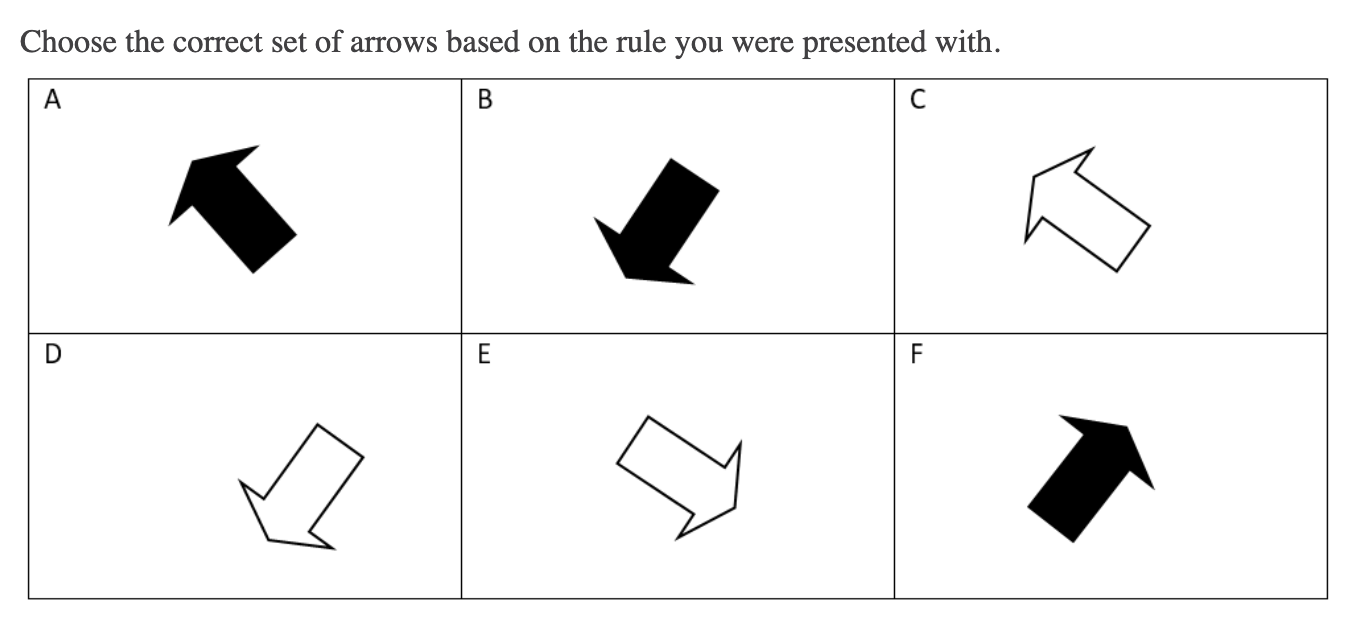
Remember:
In our actual prep material and on the ACT exam, you won't see the rules and answer options at the same time. You'll need to memorise all rules before proceeding - once you move to the answer screen, they'll no longer be visible.
Choose your answer before looking at the explanation below.
What Is The ACT Error Detection Test?
The Army Cognitive Test Error Detection section is all about attention to detail, memory retention, and spotting discrepancies quickly and accurately.
You'll face approximately 40 questions within a 5-minute time limit.
Each question is presented in two stages:
- Stage 1: You're shown two strings of characters, made up of letters, numbers, or symbols, placed side by side. You must compare them carefully and count how many differences exist between the two strings.
- Stage 2: On the next screen, you'll be presented with five answer options (0, 1, 2, 3, or 4) representing the possible number of differences. You must select the correct number.
The strings are nearly identical, making the differences easy to miss under time pressure. This section punishes fatigue more than difficulty, staying accurate on question 38 is as important as question 1.
Try a British Army Error Detection test sample question:
Determine how many characters aren’t the same.
Original: 12:54 12/11/2019
Copy: 12:54 11/12/2019
Answer options:
- 0
- 1
- 2
- 3
- 4
Choose your answer before looking at the explanation below.
The correct answer is: 2
There are two differences: The "1" and "2" in the date portion are swapped in the copy, which constitutes 2 differences.
Even a small improvement in your Error Detection speed can make a significant difference to your overall GTI score. Our ACT PrepPack includes dedicated Error Detection drills to sharpen your focus and build the accuracy you need on test day.
What Is The ACT Number Fluency Test?
The Army Cognitive Test Number Fluency section is about reading, understanding, and applying numerical information. Despite the name, it's less about advanced maths and more about your aptitude with numbers under time pressure. All questions use basic GCSE-level arithmetic.
You'll have 7.5 minutes for around 40 questions, presented in two parts:
- In the first part, you're shown two simple equations using basic mathematical operators (addition, subtraction, multiplication, and division) and must calculate the answer to each.
- On the next screen, you're asked to identify which equation had the higher answer, or whether both were equal. You cannot go back to check your previous answers, so you must rely on memory as well as quick calculation.
The difficulty isn't the maths itself, it's holding onto your results and comparing them fast, with no second chances to check back.
See how you do on a British Army Number Fluency test sample question:
Look at the following two calculations:
- Calculation 1: 6 x 9
- Calculation 2: 7 x 8
Here, you must decide which calculation is greater, the top one or the bottom one, or, alternatively, if both are equal.
It's worth noting that, in our actual prep material and on the ACT exam, you won't see the two equations at the same time, so you'll need to retain your answers.
Question: Which calculation is greater?
- Top
- Bottom
- Same
Choose your answer before looking at the explanation below.
What Is The ACT Word Rules Test?
The ACT Word Rules section draws on your verbal reasoning, working memory, and ability to recall word associations under time pressure, skills essential for processing instructions quickly and accurately in Army roles.
You have a 7.5-minute time limit to master approximately 40 questions.
Each question is presented in three stages:
- Stage 1: You're shown three word categories in a specific order. You must read and memorise which category corresponds to each position before proceeding.
- Stage 2: The categories disappear and are replaced by three words. You must assess how many of the words match their corresponding category in the same position.
- Stage 3: The words are hidden and you must select the correct number of matches, between 0 and 3.
Like the Orientation and Deductive Reasoning sections, you cannot go back once you have progressed. Getting this right comes down to absorbing category rules quickly and applying them without hesitation once the words appear.
Let's take a look at a British Army Word Rules test sample question:
In Word Rules, you need to see if any items match the categories given.
For example:
- Categories: Colour Colour Colour
- Items: Pink Cyan Rope
It's worth noting that in our actual prep material and on the ACT exam, the categories and words are not presented at the same time. You'll need to memorise both the categories and their order before proceeding. Once you move to the next stage, the categories will no longer be visible.
Question: How many items match the category above them?
- 0
- 1
- 2
- 3
Choose your answer before looking at the explanation below.
The correct answer is 2.
Pink is a colour and Cyan is a colour, but Rope is not a colour. Therefore, only two items match the rule.
Word Rules is as much a memory test as a language test. Our ACT PrepPack includes targeted Word Rules drills to help you build the recall speed and verbal pattern recognition you need to perform well on test day.
What Is The ACT Deductive Reasoning Test?
The ACT Deductive Reasoning section draws on logic to help you reach correct conclusions from the information you're given, a core skill for decision-making in Army roles.
You'll get 7.5 minutes for roughly 50 questions.
Each question is presented in two stages:
- Stage 1: You're shown two statements describing comparative relationships between elements. For example, "X is taller than Y" or "A is faster than B." You must read, understand, and memorise these relationships before proceeding.
- Stage 2: A question is presented based on those relationships and you must select the correct answer from memory, using logical deduction.
The relationships themselves are straightforward, but the challenge lies in the abstract format, the memory element, and the strict time pressure. What separates strong performances here is holding the comparison in mind cleanly enough to trust your first conclusion.
Test yourself with a British Army Deductive Reasoning test sample question:
In deductive reasoning, you'll be shown two facts and must then answer a question based on them. The answer needs to be according to the logic the two facts dictate.
For example:
- Phone call before email.
- Letter after phone call.
Question: Which is first?
- Phone call
- Letter
Choose your answer before looking at the explanation below.
The correct answer is: Phone call
The information given suggests that the phone call is before both the email and letter, so this must be the correct answer.
Deductive Reasoning is one of the most unfamiliar sections for many candidates, but with the right practice, it's highly improvable. Our ACT PrepPack includes dedicated drills to help you master the format and answer with confidence under time pressure.
The ACT forms part of the broader Army Aptitude Test process, which also includes the optional Technical Selection Test for candidates applying to technical roles, and Army Numeracy and Literacy Tests for candidates without GCSE English and Maths at Grade C/4 or above.
⭐️ Golden Tip: The Army Cognitive Test is extremely fast-paced, so prioritise speed over perfection. If a question takes more than a few seconds to solve, make your best guess and move on. The ACT rewards candidates who can quickly recognise patterns, eliminate unlikely answers, and maintain a steady pace across all sections. Staying calm and keeping momentum is often more important than solving every question perfectly.
What Are Army Cognitive Test Passing Scores?
The Army Cognitive Test doesn't have a universal pass mark, and there's no single Army Cognitive Test score requirement that applies to every applicant.
Instead, your Army Cognitive Test scores are calculated from your performance across all five sections, producing a General Trainability Index (GTI) score that determines which roles you're eligible for. The exact weighting of each section is not publicly disclosed, but strong performance across all sections gives you the best chance of achieving a high GTI.
Scores are allocated based on both accuracy and speed: The faster you answer correctly, the higher your score.
There's no official average score published, but familiarity with the question formats gives you a real edge over candidates seeing them for the first time.
- A minimum GTI of 26 is required to progress through the Army recruitment process
- A GTI of 60 is generally needed to access the widest range of career paths
- Higher scores unlock more technical, intelligence, and specialist roles
- Lower scores may still qualify you for combat or support roles, but options will be more limited
No single section can compensate for weak performance elsewhere - consistent performance across all five sections is key to your overall Army Cognitive Test results.
Below are examples of typical minimum GTI scores for some roles:
| Role Description | GTI (ACT Score) Minimum |
|---|---|
| Household Cavalry Crewman / Mounted Duty | 44 |
| The Rifles / Parachute Regiment (Junior Entry) | 34 |
| The Rifles / Parachute Regiment (Senior Entry) | 26 |
| Royal Artillery | 38 |
Note: These scores are approximate and may change depending on Army recruitment needs.
Army Cognitive Test Tips
The Army Cognitive Test measures how quickly and accurately you can process information. With around 200 questions in just 45 minutes, staying focused while keeping up the pace is what separates a strong result from an average one.
A few strategies make the biggest difference:
- Practise working quickly: You have roughly 10 seconds per question, so train with timed practice tests to build speed and confidence.
- Train your memory: Several ACT sections (Orientation, Word Rules, and Deductive Reasoning) require you to memorise information before answering. Practising memory-based questions will give you a significant advantage.
- Learn to recognise patterns: Many questions rely on spotting numerical, verbal, or logical patterns. The faster you recognise these, the quicker you can reach the correct answer.
- Don't get stuck on difficult questions: If a question takes too long, make your best guess and move on. Maintaining momentum is crucial in such a fast-paced test.
- Improve your mental maths: Strong arithmetic skills will help you answer Number Fluency questions more efficiently.
- Stay calm and focused: The test is designed to feel fast, but staying calm helps you think clearly and avoid simple mistakes.
- Look after the basics before test day: Get a proper night's sleep, eat something before you sit down, and avoid cramming last minute. A clear head does more for your score than one more practice session at midnight.
The most effective way to build both speed and accuracy is through realistic Army Cognitive Test practice - our PrepPack helps you get there.
Master Your Army Cognitive Test
Consistent, timed practice is what actually moves your GTI score, not last-minute cramming the night before.

Army Cognitive Test FAQs
Mindmill is a psychometric assessment platform used by various organisations, including the British Army, to assess the cognitive abilities and potential of candidates during the recruitment process. The platform helps test candidates' reasoning, problem-solving, and aptitude skills. It's typically used for online assessments, such as the ACT, allowing candidates to complete the test remotely.
Yes. The British Army accepts applications from Commonwealth citizens, provided they meet the eligibility requirements.
Applicants must usually meet criteria such as age limits, medical standards, and English language requirements, and they must have the legal right to live and work in the UK or be eligible under the Army’s recruitment rules at the time of application.
Because recruitment policies can change, candidates from Commonwealth countries should always check the latest guidance on the official British Army recruitment website before applying.
The Army Cognitive Test (ACT) is usually completed online early in the recruitment process after you submit your application. Most candidates take it remotely from home through the Army’s online recruitment system.
In some cases, candidates may also complete additional assessments later at an Army Assessment Centre, but the ACT itself is typically taken online before attending the centre.
The Army's own Mindmill platform lets you try each ACT format for free before your real assessment. Our PrepPack goes further, with full-length timed tests, targeted drills, and study guides for every section, so you're not just familiar with the format but genuinely prepared for it.
The ACT sample questions may appear easy, but the time pressure makes the test challenging. Completing the test within the time limit requires quick thinking, strong concentration, and the ability to recognise patterns rapidly. Many candidates find the biggest challenge is balancing speed and accuracy while maintaining focus throughout the test.
How much time you should invest into preparation depends on your prior experience with cognitive tests, as well as your existing knowledge of numerical, language, or reasoning problems. Generally, though, short bursts of targeted practice over multiple days will serve you better than cramming before your assessment.
A minimum GTI score of 26 is needed to progress through Army recruitment, but a score of 60 is generally considered a strong result that opens up the widest range of career paths. There is no single good score, though. It depends entirely on which roles you're applying for and their individual GTI requirements.
There's no fixed pass or fail line on the ACT itself, since it's scored as a GTI rather than pass/fail. In practice, though, if your score falls below the minimum GTI needed for any role, you won't be able to progress at that time, and your recruiter will talk through your options with you.
After completing the ACT, your score determines which Army roles you're eligible for. If you achieve the required score for your chosen role, you'll continue through the recruitment process.
The next stages typically include medical assessments, physical fitness tests, additional role-specific tests (if required), an Army Assessment Centre visit, and a formal interview.
These stages help the Army evaluate your fitness, suitability for the role, and overall potential as a soldier.
Read more about the selection process in our British Army Recruitment Process guide.
Our PrepPack can't guarantee entry, but it will help you prepare for the Army Cognitive Test so you can at least rest assured you have all the basics covered.
ACT PrepPack Reviews
Why Trust JobTestPrep?
Founded in 1992, JobTestPrep has built over three decades of experience helping candidates navigate competitive recruitment processes, including thousands preparing for the British Armed Forces and assessments like the Army Cognitive Test. Our preparation materials are developed by experts and regularly updated to reflect the latest test formats, helping candidates approach every stage with greater confidence. With more than 220 preparation courses and over one million candidates supported worldwide, we offer professionally designed PrepPacks alongside advanced tools, including our AI-powered CV Analyser and Interview Prep platform. Together, these resources help candidates across the UK and globally strengthen their applications, improve their performance, and achieve outstanding results.


More On The British Army
If you're preparing for British Army assessments, you might find these other resources helpful:
Also check out our guides on Army Aptitude Tests and the British Army Recruitment Process.


