British Army Recruitment Process: Your Preparation Guide (2026)
Last updated: 7 August 2026 | Trusted by thousands worldwide.
Joining the British Army as an enlisted soldier is a structured and challenging process that typically takes around six months from your initial application to starting training, though timelines vary depending on your chosen role and how quickly you progress through each stage.
The British Army recruitment process for Regular Army soldiers is designed to assess your suitability for military service on all levels (mentally, physically, and personally), and evaluates candidates based on their aptitude, fitness, teamwork, and ability to complete basic training. Those pursuing a commission as an officer follow a different path, typically involving university-level courses and leadership training at the Royal Military Academy Sandhurst.
Understanding each stage of the Army selection process will help you prepare effectively, avoid surprises, and maximise your chances of securing the role you want.

Eligibility & Application
Before beginning the recruitment process, you'll need to check whether you meet a set of basic eligibility requirements. These requirements ensure candidates are legally able to serve and physically capable of completing military training.
- Age: Most roles accept applicants between 16 and 35 years old, but some specialist roles or reserve positions will allow older applicants.
- Nationality: Applicants normally have to be a British citizen, Irish citizen, or a Commonwealth citizen with the legal right to live and work in the UK.
- Education: Many entry-level Army roles don't require formal qualifications, but candidates are expected to demonstrate basic literacy and numeracy skills, while technical or specialist trades may require GSCEs or equivalent qualifications, particularly in English and Maths.
- Medical standards: All applicants must be able to pass medical screenings that assess general physical fitness, vision and hearing, musculoskeletal health, and mental health.
- Criminal record: Minor offences may not automatically disqualify you but serious convictions, particularly those involving violence, drugs, or sexual offences, are likely to prevent enlistment.
If you meet the basic eligibility requirements, you can submit an online application to join the British Army through the official Army recruitment system.
At this stage, you're not committing to a specific job. The application only serves to allow the Army to begin assessing your suitability and guiding you towards appropriate roles.
Initial Interview & Screening
After submitting your Army application, you'll usually be contacted by a Candidate Support Manager, who'll act as your recruiter throughout the process.
They may confirm your eligibility, discuss your preferred roles, explain the next stages of recruitment, and provide guidance on preparing for assessments. They'll usually remain your primary point of contact.
One of the first more formal steps after submitting your application is completing an online medical questionnaire, which asks about past medical conditions, injuries and surgeries, current medications, mental health, and allergies or chronic conditions.
It's essential to answer these questions honestly and accurately, as any undisclosed medical issues discovered later in the recruitment process could result in your application being withdrawn.
If you've passed the initial eligibility screenings, you'll progress to the next stage of the recruitment process, which usually involves an initial interview with your recruiter and further medical checks or documentation, as well as preparation for aptitude tests and the Army Assessment Centre.
British Army Aptitude Tests
After completing the initial steps in the British Army selection process, you'll move on to the Army aptitude tests.
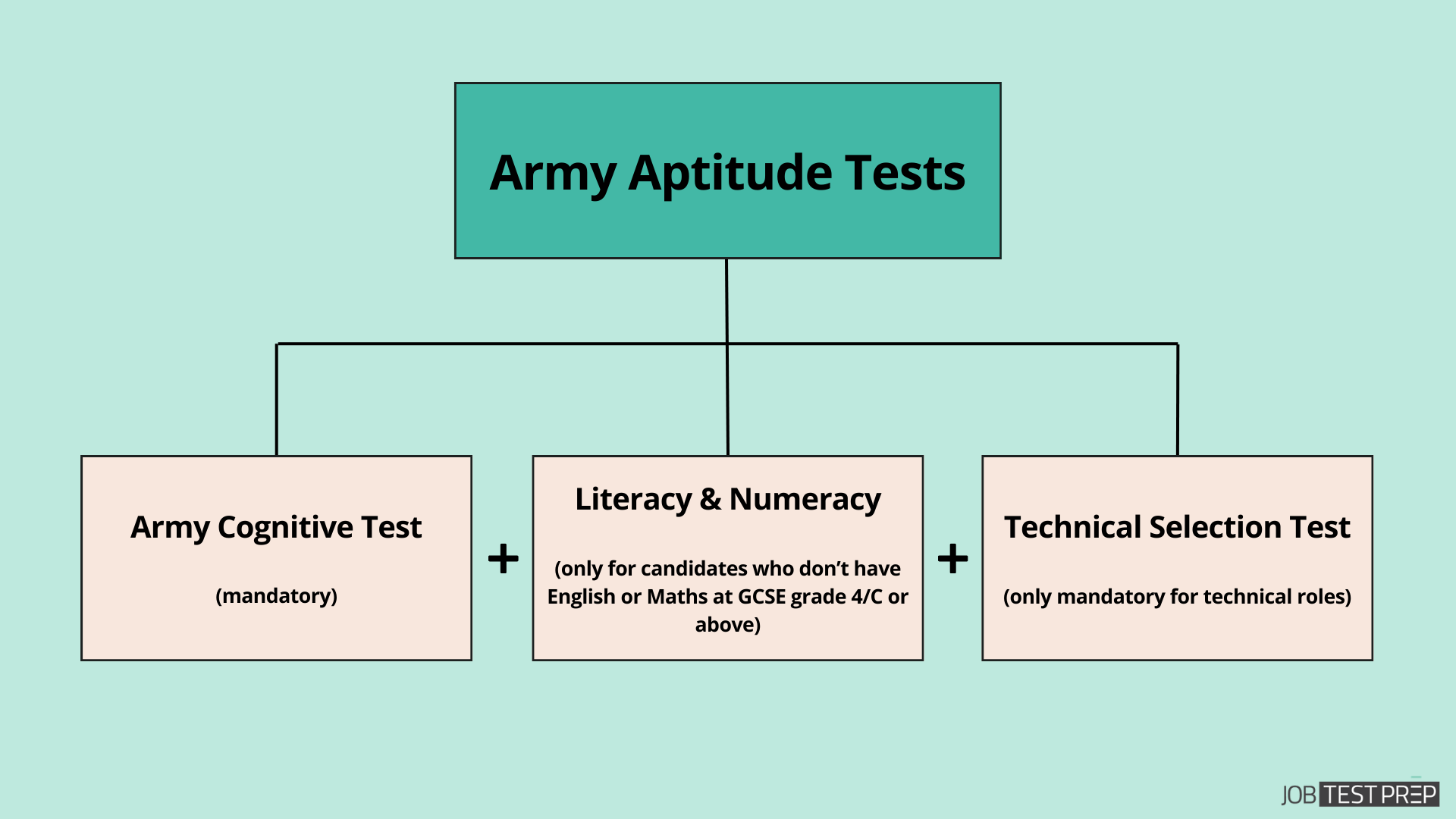
These assessments determine your suitability for different roles within the Army and measure your cognitive, literacy, and numeracy skills.
British Army Cognitive Test
The Army Cognitive Test (ACT) evaluates your reasoning, problem-solving, and comprehension skills, and is the main aptitude test used as part of the British Army recruitment process. The test is usually completed online before attending the Army Assessment Centre.
The ACT replaced the older British Army Recruit Battery (BARB) test, which was previously taken at the selection centre.
The ACT test assesses:
- Verbal reasoning (understanding written information)
- Numerical reasoning (solving basic arithmetic, percentages, ratios, and word problems)
- Logical reasoning (identifying patterns, sequences, and abstract problem-solving)
- Situational judgement (only for some roles - making decisions in realistic Army scenarios)
Your performance produces a General Trainability Index (GTI) score, which determines the roles you're eligible for. Higher scores give access to more technical or specialised trades, while lower scores may limit your options to general soldier roles.
The Army aptitude test is an important part of the application process since it can determine your entire future in the British Army. Therefore, preparation is key. We offer a comprehensive Army Cognitive Test preparation package that'll help you prepare for all aspects of the British Army aptitude test.
Ace Your Army Cognitive Test
Master expert strategies and techniques with our dedicated Army Cognitive Test PrepPack.
British Army Literacy & Numeracy Tests
While the ACT covers the majority of literacy and numeracy assessment, candidates who do not have GCSEs in English or Maths at grade 4/C or above may have to sit for an additional Army Maths test or Army English test to ensure they meet minimum standards.
These checks are designed to confirm that all recruits can understand instructions, follow orders, and perform basic calculations, which are essential skills for Army training and operations.
- Army Numeracy Test: Simple arithmetic, fractions, decimals, percentages, and ratios, word problems and real-life calculations relevant to Army tasks, interpreting simple tables or charts
- Army Literacy Test: Reading comprehension exercises, grammar and sentence structure questions, spelling and vocabulary checks to ensure clarity of communication
Candidates without GCSEs should spend extra time practising basic arithmetic and reading comprehension. Timed practice under realistic conditions can improve speed and accuracy, which is important for passing with a high score.
British Army Technical Selection Test (TST)
The Technical Selection Test (TST) is only required for candidates applying for technical or specialist roles, such as communications, intelligence, engineering, or signals trades.
The TST is more advanced than the standard ACT numeracy and reasoning questions, and is designed to assess whether a candidate can handle the mathematical, logical, and problem-solving demands of these technical roles.
The TST typically includes:
- GCSE-level mathematics, including percentages, ratios, algebra, and geometry
- Applied problem-solving, often framed in technical or Army-relevant scenarios
- Logical reasoning, pattern recognition, and sequencing tasks
- Situational or scenario-based questions that test analytical thinking
Candidates applying for technical trades should focus on practice questions that mimic the style of the TST. Scores on the TST can be decisive in determining which specialist roles you're eligible for, so preparation is essential.
Ace Your Technical Selection Test
Specialist roles demand specialist skills. Tackle technical, numerical, and problem-solving challenges with our targeted TST PrepPack.
British Army Assessment Centre (AAC)
After successfully completing the Army aptitude tests, candidates progress to the Army Assessment Centre (AAC).
The AAC was previously known as the Army Development and Selection Centre (ADSC). While the name has changed, the purpose remains the same: To assess your suitability for Army service through a combination of physical, mental, and interpersonal evaluations.
The assessment usually runs over three days and travel, accommodation, and meals are provided at no cost. You'll generally be sent a detailed invitation explaining exactly what documentation, clothing, and equipment to bring.
During the assessment, candidates complete a series of tasks, including:
- Physical fitness tests: These evaluate your strength, endurance, and general fitness. They include the powerbag lift (lifting weights from 15 kg up to 40 kg onto a 1.45 m platform), the jerry can carry (lifting and carrying two 20 kg cans over a set distance), and the 2.4 km (1.5 mile) run. Standards vary depending on your age, gender, and chosen role.
- Medical assessment: A full examination is carried out to confirm physical and mental fitness. This includes checks of your vision, hearing, musculoskeletal health, cardiovascular and respiratory systems, and mental wellbeing. Any issues identified here may require further documentation from your GP.
- Icebreaker presentation: Each candidate delivers a short presentation about themselves and on a topic chosen by the assessors. This exercise evaluates communication skills, confidence, and how well you articulate information.
- Teamwork exercises: These are collaborative, mentally and physically challenging tasks designed to test your ability to work effectively in a team, demonstrate leadership potential, and show motivation and respect for others under pressure.
- Memory exercise: On day 1, candidates are given a short lesson on an Army-related topic, during which they can take notes. The following day, a memory test assesses how well you retained the information without your notes.
- Interviews: A final formal interview reviews your overall performance across all exercises. Assessors evaluate your suitability for Army roles based on teamwork, motivation, communication, problem-solving, and personal qualities.
Your overall performance at the AAC is combined to produce a grade, which influences your placement in the British Army.
While your cognitive test results determine which roles you are eligible for, the Army Assessment Centre evaluates your physical fitness, teamwork, and interpersonal skills to confirm suitability and finalise role assignments.
To prepare, ensure you're physically fit, familiarise yourself with Army procedures, practise teamwork and problem-solving tasks, and bring all required documentation and equipment as specified in your invitation.
What Happens After Assessment At The AAC?
Once you've completed all stages of the recruitment process, your results are reviewed to determine your suitability for Army service.
Your Candidate Support Manager will contact you to confirm your assessment outcome and discuss your final role offer, which depends on your performance across all assessments and the availability of Army positions. Before joining, you may need to complete any remaining checks, such as final medical or security screenings.
Once all requirements are satisfied, you'll start Phase 1 Training, where you'll develop the fitness, skills, and discipline required for a successful career in the British Army.
Completing the British Army recruitment process is a major achievement. Each stage is designed to ensure you're ready for the demands of Army life and prepares you for a successful start to your military career.
Take A Closer Look At Our Army Prep Opportunities
Preparing for the British Army recruitment tests can feel daunting. But with the right tools and the right practice, you can build the skills and confidence to succeed and secure the Army role you want.
Our preparation packs and free practice pages are expert-created and designed to mirror real test conditions, helping you familiarise yourself with the types of questions you’ll face and the pace you’ll need to maintain.
View all our British Army preparation opportunities:
- Army Cognitive Test (ACT) PrepPack
- Army Literacy Test Practice
- Army Numeracy Test Practice
- Technical Selection Test (TST) PrepPack
- Army Officer Selection Board (AOSB) PrepPack
You can also check out our guides and preparation packages for the Royal Air Force and the Royal Navy.
Prepare For Your Army Tests
Get all the help you need to prepare for the challenging army aptitude tests with our expert-created Army Cognitive Test PrepPack.

British Army Recruitment FAQs
You can apply to join the British Army online through the official Army recruitment portal. During the application, you'll provide your personal details, confirm your eligibility, and indicate your preferred roles. At this stage you're not committing to a specific job - the application allows the Army to begin assessing your suitability and guide you towards appropriate roles. Once submitted, a Candidate Support Manager will contact you to discuss next steps.
The British Army recruitment application form is available on the official Army recruitment website.
The British Army selection process takes candidates through several structured stages, each designed to assess a different aspect of your suitability for military service:
- Eligibility check and online application: Confirming you meet the age, nationality, medical, and education requirements
- Initial screening and interview: A conversation with your Candidate Support Manager to discuss your preferred roles and next steps, including an online medical questionnaire
- Army aptitude tests: Including the Army Cognitive Test (ACT), and additional literacy, numeracy, or technical tests depending on your chosen role
- Army Assessment Centre (AAC): A multi-day evaluation covering physical fitness tests, a full medical assessment, teamwork exercises, an icebreaker presentation, a memory exercise, and a formal interview
- Final role offer: Based on your combined performance across all stages and role availability
Once all stages are completed successfully, candidates begin Phase 1 Training.
The initial online application itself is relatively straightforward and can typically be completed in a single sitting. However, the application is just the first step. The subsequent stages, including aptitude tests, medical checks, and the Army Assessment Centre, extend the overall timeline. The full British Army recruitment process typically takes at least six months from initial application to starting Phase 1 Training.
The British Army recruitment process typically takes at least six months from initial application to starting Phase 1 Training, and often longer.
Timelines vary depending on your chosen role, how quickly you complete each stage, and the availability of Assessment Centre dates.
As a rough guide:
- The online application and initial screening takes 1 - 2 weeks
- Aptitude tests are usually completed within the first month
- The Army Assessment Centre is typically scheduled a few months after applying, sometimes within 2 - 4 months, though waiting times vary
- Phase 1 Training start dates are allocated after your final role offer, which can add several more months depending on intake availability
Staying responsive to your Candidate Support Manager and preparing thoroughly for each stage are the most effective ways to move through the process efficiently.
As part of the British Army selection process, you'll be invited to attend the Army Assessment Centre (AAC), previously called the Army Development and Selection Centre (ADSC). This is where you complete physical tests, team exercises, memory assessments, and interviews. Regular Soldier Assessment Centres for the British Army are located in Belfast, Glencorse (Scotland), Lichfield, and Pirbright.
The British Army recruitment process is challenging by design, since joining the British Army requires candidates to demonstrate that they are mentally, physically, and personally ready for military service.
Candidates must pass eligibility checks, the Army Cognitive Test, literacy and numeracy assessments (if required), the Army Assessment Centre with physical and teamwork exercises, and final medical and security checks.
Difficulty can vary depending on your role and fitness level. Some roles, particularly technical or specialist trades, have higher academic or aptitude requirements, while all candidates must meet physical fitness standards.
Preparation is key: Practising aptitude tests, improving fitness, and familiarising yourself with Army procedures can significantly improve your chances of success.
Many candidates successfully complete the process each year, but the selection process is designed to be rigorous to ensure only those ready for Army life are offered roles.
Most entry-level soldier roles do not require formal academic qualifications. Candidates must demonstrate basic literacy and numeracy, and those applying for technical or specialist trades may need GCSEs or equivalent qualifications in English and Maths. Your performance in the Army Cognitive Test and other aptitude assessments plays a significant role in determining which roles you are eligible for.
You do not necessarily need a UK passport. Citizens of the Commonwealth and those with legal rights to live and work in the UK may also apply, though eligibility requirements vary depending on nationality and the role applied for.
Many entry-level Army roles do not require formal qualifications. However, candidates are expected to demonstrate basic literacy and numeracy skills, and technical or specialist trades may require GCSEs or equivalent qualifications, particularly in English and Maths. Candidates without GCSEs in these subjects may be asked to sit additional Army literacy and numeracy tests as part of the recruitment process.
A criminal record doesn't automatically disqualify you from joining the British Army. Minor offences may not prevent enlistment, but serious convictions, particularly those involving violence, drugs, or sexual offences, are likely to result in your application being rejected. Please note that we are not legal professionals and this should not be taken as legal advice. Each case is assessed individually, so we recommend contacting the Army recruitment team directly for guidance specific to your circumstances.
The British Army officer recruitment process differs significantly from the enlisted soldier pathway. Rather than progressing through the standard Army Assessment Centre, officer candidates are assessed through the Army Officer Selection Board (AOSB), which evaluates leadership potential, cognitive ability, and personal qualities to a higher standard. Officer entry also typically involves university-level courses and leadership training at the Royal Military Academy Sandhurst. If you're considering an officer career, we recommend exploring our dedicated AOSB preparation resources.
Why Trust JobTestPrep?
Founded in 1992, JobTestPrep has built more than three decades of experience helping candidates navigate competitive recruitment processes, including thousands preparing for the British Armed Forces. Our preparation materials are developed by experts and regularly updated to reflect the latest test formats, helping candidates approach every stage with greater confidence. With more than 220 preparation courses and over one million candidates supported worldwide, we offer professionally designed PrepPacks alongside advanced tools, such as our AI-powered CV Analyser and Interview Prep platform. Together, these resources help candidates across the UK and globally strengthen their applications, improve their performance, and achieve outstanding results.
Kemi, Army Tests Developer