


What Does SHL Really Measure? Behaviours, Competencies and Ability
 What Does SHL Really Measure? Behaviours, Competencies and Ability
You've been invited to an SHL assessment. Waiting for you is an OPQ personality questionnaire, a reasoning test, a checking task, or maybe a workplace scenario.
These tests look very different from each other because each one measures something different. Most of them, though, feed into the same question:
SHL doesn't work with one fixed idea of "ability". Depending on the role, an employer may want to know about your workplace behaviours, skills, competencies, personality, cognitive ability, or a mix of these.
Once you know which is which, the SHL process is much easier to follow and you can prepare for the right thing. If you'd like to see the question types first, try our free SHL practice tests, with sample numerical, verbal, inductive and deductive reasoning questions.
All SHL tests follow the same measurement logic. Below, we use four of them to show how it works: the OPQ, Management Scenarios, checking tasks and inductive reasoning.

TL;DR
- Behaviours are specific actions or patterns of behaviour at work.
- Related behaviours can contribute to broader skills.
- Competencies describe sets of behaviours associated with successful workplace performance.
- A job profile can require several competencies rather than one generic definition of a good employee.
- The OPQ looks at your preferred workplace behavioural style.
- Checking and cognitive ability tests look more directly at what you can do when performing a task or solving a problem.
- The same job requirement can sometimes be examined from several angles. Attention to detail is a good example.

From Behaviours to Skills
At the most specific level, we can think about individual workplace behaviours. One example used by SHL is "Encourages others to express their views". It describes a relatively specific action that a person may demonstrate at work.
Looking at every possible workplace behaviour separately would quickly become impractical, so SHL groups related behaviours into broader constructs. Behaviours such as encouraging another person to speak, seeking their perspective, and paying attention to what they say can contribute to a broader skill such as Listens Attentively.
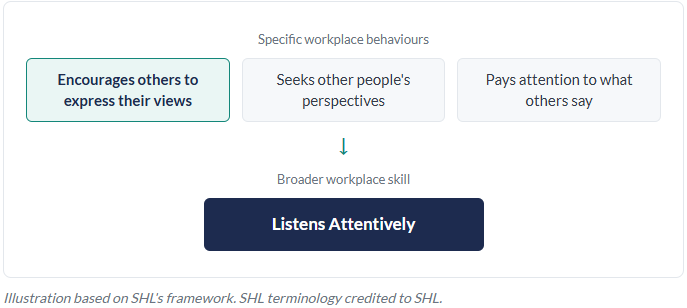
SHL's Global Skills Assessment is based on 96 universal workplace skills across eight broad domains. SHL describes these skills as underpinning workplace behaviours and competencies.
So, at a simplified level, specific workplace behaviours build into broader workplace skills. But skills are only one part of the picture.
What Is a Competency?
SHL's Universal Competency Framework defines competencies as sets of desirable behaviours. It also distinguishes competencies from the underlying attributes, such as personality and cognitive ability, that can affect a person's potential to demonstrate those behaviours.
This becomes easier to understand through a management example:
Example: People Management
Imagine you manage a team of 10 people. Lina, one of your strongest employees, recently applied for a senior coordinator position but was unsuccessful. Since then, she has remained professional, but she has become quieter in meetings, less supportive of colleagues, and noticeably colder towards you. You are entering a busy period and are concerned that the situation could begin to affect the wider team.
Which response shows stronger managerial judgement?
A Job Profile Can Require Multiple Competencies
One competency rarely defines an entire role.
SHL distinguishes between general competencies and the competency requirements created by a particular job and work environment. According to SHL's Universal Competency Framework, these requirements should derive from the demands made on people by the job and the organisation.
A management role, for example, might require People Management alongside strong planning, decision making, objective management, and influencing behaviours. Together, those requirements create a broader job profile.
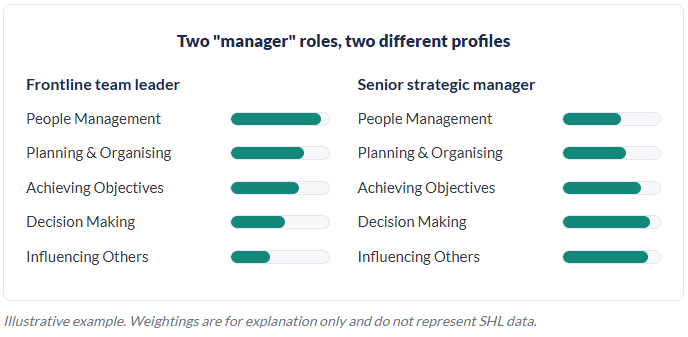
This also explains why two positions containing the word "manager" may not require exactly the same profile. A frontline manager responsible for day-to-day employee performance may need a different balance of competencies from a senior manager responsible for strategy and cross-functional influence.
Employers are therefore not necessarily looking for one universal version of the ideal candidate. They are interested in how closely a person's profile matches the requirements of a particular job.
Where Does the OPQ Fit In?
The SHL Occupational Personality Questionnaire (OPQ) provides a different type of information. The current version is known as the OPQ32r, and SHL describes it as a measure of workplace behavioural style.
Rather than asking whether you can solve a problem correctly, the OPQ looks at how you typically prefer to behave at work. Consider this JobTestPrep OPQ-style statement:
I follow a systematic approach
A response to a statement like this can help build a picture of how systematically and carefully someone tends to approach their work.
One of the 32 characteristics measured by the OPQ is Detail Conscious, within the broader Structure area. SHL describes the OPQ as a forced-choice, untimed personality questionnaire whose 32 characteristics can be mapped to competencies required by a job. A result can then contribute to a profile such as:
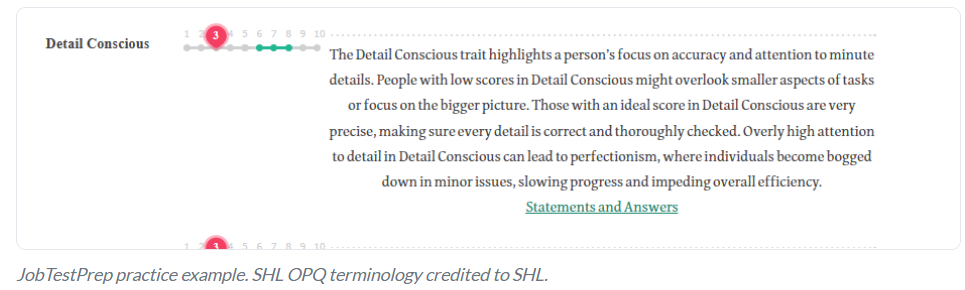
The important distinction is that the OPQ describes behavioural style. It does not directly test whether you can detect an error accurately.
That gives us one of the most useful examples of how SHL can look at a job requirement from more than one angle.
Attention to Detail: One Requirement, Different Types of Evidence
Imagine that a job requires a very high level of attention to detail. An employer might be interested in two separate questions:
- Does this person tend to approach work carefully and systematically?
- Can this person actually maintain accuracy when distinguishing between highly similar information?
Those questions are related, but they require different evidence.
Attention to Detail as Behavioural Style
An OPQ-style statement such as "I follow a systematic approach" can contribute to information about whether structured, methodical working is characteristic of the person's preferred style. This is about how the person typically approaches work.
Attention to Detail as Demonstrated Performance
Now consider a checking task. The candidate sees a sequence of letters and must identify the exact same sequence among very similar alternatives:
Find the exact match for:
DBRME
Or the candidate may see a number and need to find its exact match:
Find the exact match for:
8465731


