Talogy's Cubiks Online Test Results & Score Reports (2026)
Updated: 10 February 2026
It's completely normal to feel unsure about what your Talogy or Cubiks Logiks assessment results mean.
Unlike traditional exams, Cubiks tests don't simply tell you whether you passed or failed. Instead, they rank your performance against other candidates, using somewhat confusing scoring systems like percentiles and stanines.
So let's take a closer look at how to interpret your Logiks test scores, what counts as a good result, and why practice is the key to getting the results you want.

What Are Cubiks And Talogy Test Results?
Cubiks assessments are now delivered under the Talogy brand, meaning Cubiks test results, Logiks test results, and Talogy test results all refer to the same scoring framework, especially if we're looking specifically at the Logiks General tests.
If you need to learn more about Talogy and the Logiks General (Intermediate) and Logiks General (Advanced) tests, please refer to the linked pages.
After completing a Cubiks Logiks test, candidates typically receive a score report that includes:
- An overall test score
- Separate indicators for speed and accuracy
- Section-level results (numerical, verbal, and abstract reasoning)
- A norm-referenced score, shown as either a percentile or a stanine
Rather than measuring performance in isolation, Cubiks results show how you performed relative to other candidates who took the same test under similar conditions.
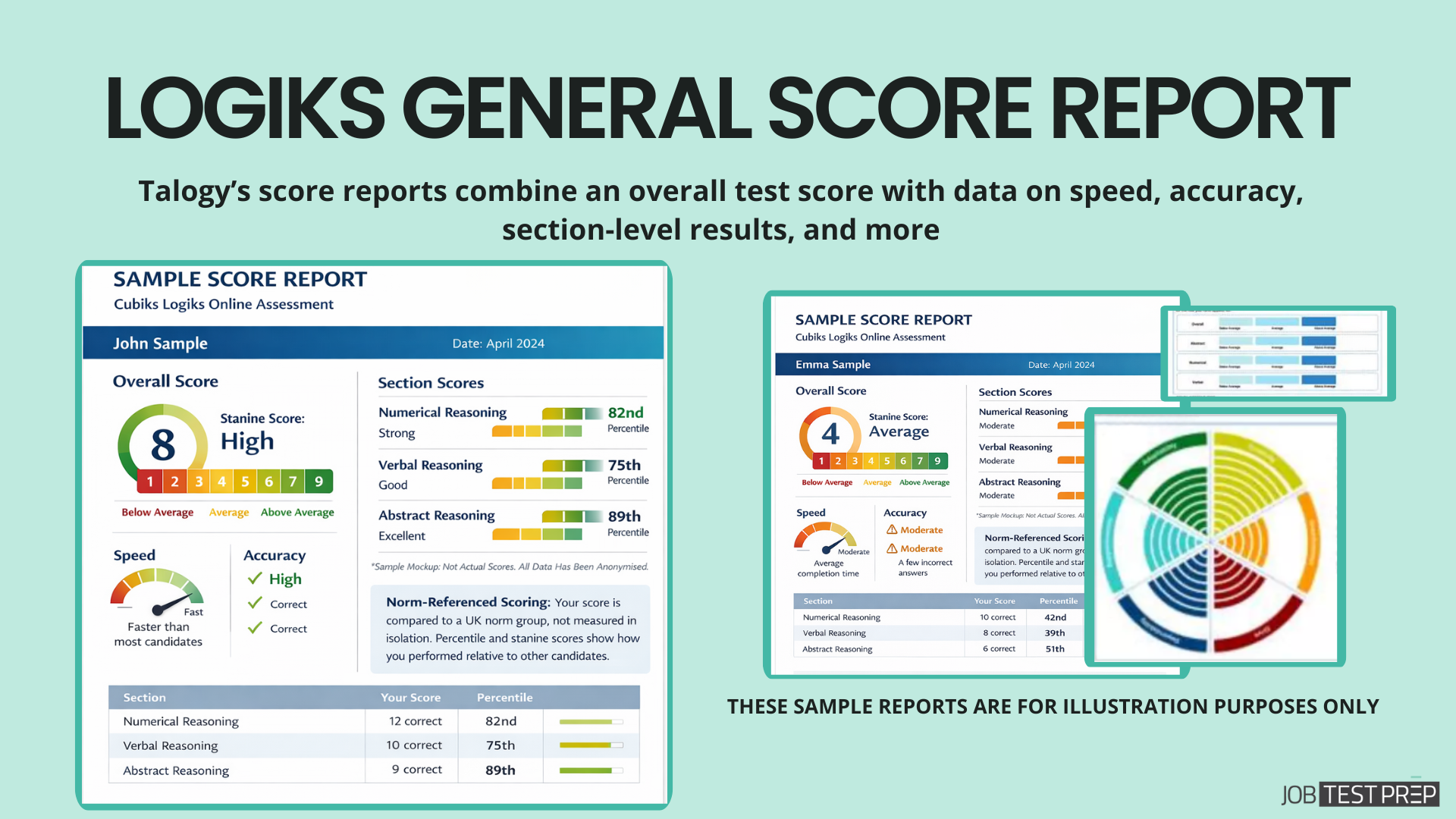
This comparative approach allows employers to identify candidates most likely to succeed in cognitively demanding roles.
How Cubiks Logiks Test Scores Are Calculated
Cubiks Logiks tests are designed to assess how efficiently you process information under time pressure.
Your final score is influenced by several factors:
- The number of correct answers
- The time taken to complete each question
- How consistently you maintain accuracy as difficulty increases
This means that two candidates with a similar number of correct answers may receive different overall rankings if one works more efficiently or manages time better. Because results are norm-referenced, your performance is always interpreted in comparison to a wider UK candidate group, not against a fixed pass mark.
Ace Your Logiks General Tests
Get all the tools you need to ace your Talogy Logiks General tests with our dedicated expert-created PrepPacks.
Understanding Your Logiks Test Score
There are two main Logiks tests, the Logiks General (Intermediate) and the Logiks General (Advanced). Both tests use norm-referenced scoring, but the specifics differ slightly.
Logiks Intermediate: Stanine Scoring
The Logiks General (Intermediate) test uses a stanine scoring system, which places candidates on a 1 - 9 scale.
- 1 - 3: Below average
- 4 - 6: Average range
- 7 - 9: Above average to high-performing
A stanine score of 5 represents the mean score, while scores of 7 or higher indicate strong reasoning ability.
Stanine scoring is frequently used for graduate schemes and high-volume recruitment, as it allows employers to quickly identify above-average performers.
Ace Your Logiks General (Intermediate) Test
Improve your chances of achieving stanine scores of 7 or higher with our in-depth Talogy Logiks General (Intermediate) PrepPack.
Logiks Advanced: Percentile Scoring
The Logiks General (Advanced) results are reported using percentile scores, which indicate how you performed compared to other test-takers.
For example:
- A 70th percentile score means you performed better than 70% of candidates
- An 80th percentile score places you in the top 20%
- A 90th percentile score indicates exceptional performance
Percentile scoring is commonly used for professional, managerial, and leadership roles because it provides employers with a precise way of comparing candidates' cognitive ability. Employers often group percentile scores into performances bands, using them to determine whether a candidate meets the intellectual demands of the role.
Many other UK-focused psychometric and talent assessment providers use percentile scoring, including SHL, Kenexa, Thomas International GIA, Saville, and more.
Ace Your Logiks General (Advanced) Test
Increase your chances of landing in the top 20% by relying on expert-created abstract, verbal, and numerical practices in our Talogy Logiks General (Advanced) PrepPack.
What Is A Good Cubiks Score?
There is no universal pass mark for Cubiks or Logiks assessments. Each employer sets benchmarks based on the complexity and cognitive demands of the role.
That said, in UK recruitment processes, a Logiks Intermediate stanine score of 7 or above is typically competitive, while a Logiks Advanced score in the 75th - 85th percentile or higher is generally considered strong.
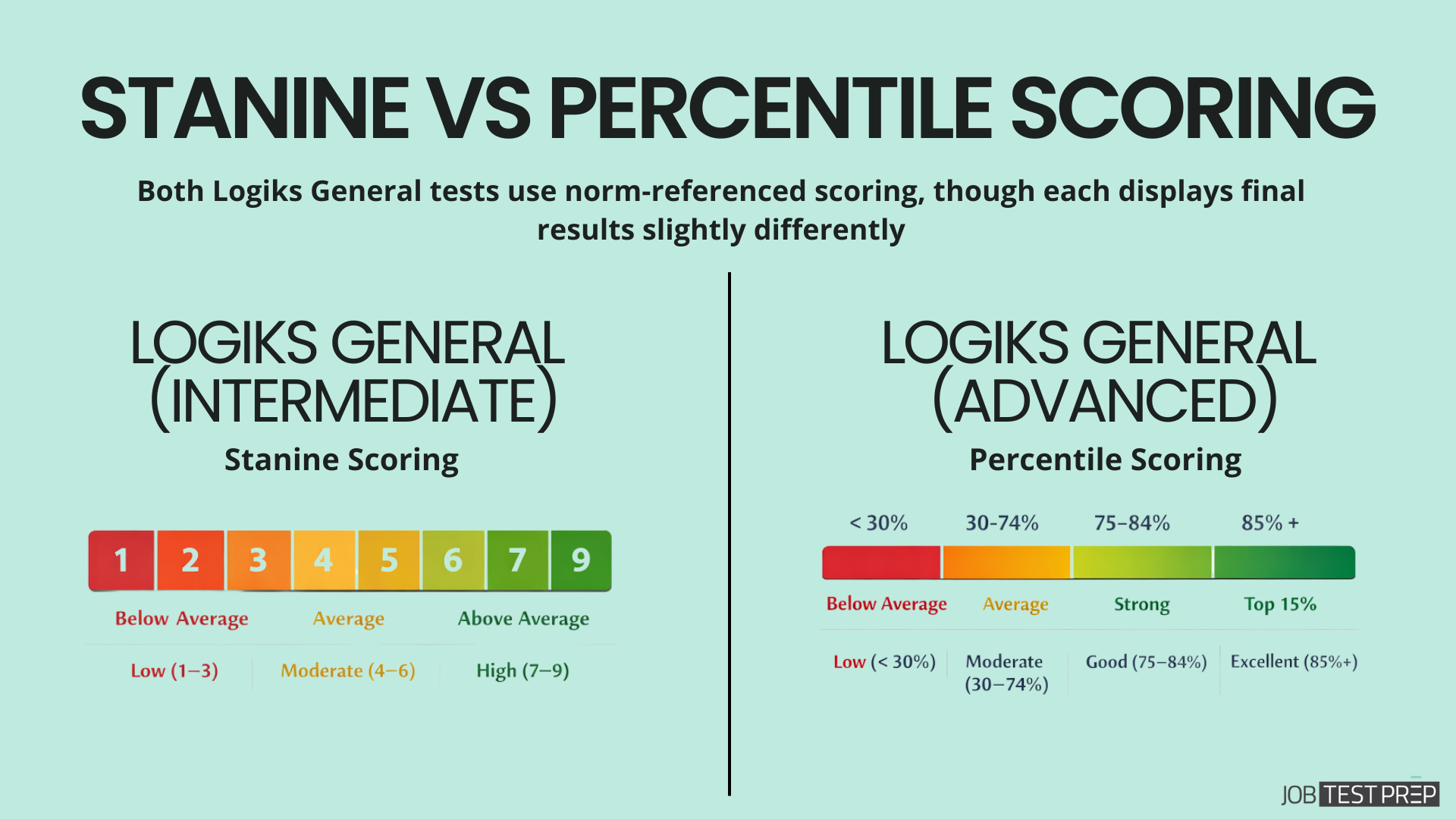
Highly selective roles often focus on candidates in the top 20% of performers, though scores closer to the average range may still be acceptable for less cognitively demanding positions, depending on the employer's criteria.
How To Improve Your Cubiks Test Results
Talogy Cubiks tests are particularly sensitive to preparation and familiarity. Many candidates underperform simply because the question formats and time pressure are unfamiliar.
Practising realistic Cubiks-style questions helps candidates:
- Improve speed without sacrificing accuracy
- Recognise recurring reasoning patterns
- Manage time more effectively
- Reduce test-day anxiety
This is especially important for Logiks tests, where working efficiently under pressure is just as important as solving the problems correctly.
Targeted Talogy practice tests, like our Talogy Logiks General (Intermediate) preparation and Talogy Logiks General (Advanced) preparation packages, closely mirror the real assessments and can significantly improve percentile rankings.
You can also visit our free Talogy practice page for a taste of our more in-depth preparation packages or check out our PAPI personality questionnaire PrepPack.
Ace All Your Talogy Assessments
Don't leave your Talogy assessment results to chance: Get ready with our all-inclusive Talogy PrepPack and approach your test with confidence.

FAQs
Cubiks results are norm-referenced, meaning your score is compared to other candidates who took the same test. Results are shown as percentile scores or stanines rather than simple pass/fail outcomes.
Passing a Cubiks test depends on meeting the employer's benchmark. The best approach is to aim for high accuracy and speed. Preparing thoroughly helps you rank above average and increases your chances of success.
Lower scores are often caused by time pressure, unfamiliar question formats, prioritising speed over accuracy, or lack of prior practice. Many capable candidates underperform on their first attempt.
Retake policies are set by the employer. Some allow retesting after a waiting period, while others do not. Because opportunities may be limited, preparing thoroughly before your first attempt is strongly encouraged.
Employers usually see percentile or stanine rankings and interpretive bands rather than raw scores alone.
Your Cubiks test results are specific to the employer who requested the assessment. Generally, scores are not automatically shared across other applications. However, some organisations may use Talogy's platform to compare results if you apply to multiple roles within the same company or group.
No, Cubiks/Talogy test scores are confidential and typically only visible to the employer who commissioned the assessment. Each employer receives their own individual report, ensuring your performance is only evaluated in the context of that specific role.
Yes, many psychometric assessments in the UK use norm-referenced scoring, just like Cubiks. This includes percentile ranks and stanines, which compare your performance against a representative candidate group rather than a fixed pass mark.
While the exact format varies by test provider, the principle remains similar in that scores show how you performed relative to others, helping employers identify top candidates. Knowing this can also make it easier to interpret results if you take different types of cognitive or aptitude tests in the future.
The Personality and Preference Inventory (P.A.P.I.) test is another popular Talogy Cubiks assessment. PAPI results are also norm-referenced, meaning your answers are compared to a relevant group of candidates rather than judged as right or wrong.
Scores highlight patterns in your work preferences, interpersonal style, and behavioural tendencies, and employers use these patterns to assess whether your preferred ways of working fit with the role and organisational culture.
Mindgage is Talogy's gamified cognitive assessment that uses interactive tasks rather than traditional multiple-choice questions to measure cognitive abilities. Despite its game-like format, Mindgage is objectively scored and evaluates the same core abilities as standard aptitude tests.