Talogy's Cubiks Logiks General (Advanced) Test Preparation (2026)
 Talogy's Cubiks Logiks General (Advanced) Test Preparation (2026)
Last updated: 26 October 2026 | Trusted by thousands worldwide.
The Talogy Cubiks Logiks General (Advanced) test assesses verbal, numerical, and abstract thinking under tight time limits, with longer passages and more complex data than the Intermediate version. Its questions require both speed and precision, making familiarity with the question types essential.
Our comprehensive Logiks General (Advanced) PrepPack includes practice questions, section-specific study materials, and tracking reports to target your weakest areas, while timed simulations and expert strategies sharpen your skills and give you the confidence you need to succeed.
Logiks (Advanced)
 1-MonthAccess
 Realistic practice tests & study guides
 Created by experts with a focus on accuracy
What's Included:
- 5 Logiks General (Advanced) Simulations
- 12 Logiks Advanced Numerical Practice Materials
- 16 Logiks Advanced Abstract Practice Materials
- 6 Logiks Advanced Verbal Practice Materials
- 12 Additional Untimed Logiks Practice Tests
- 17 In-Depth Study Guides & Video Tutorials
Sitting more than one Cubiks test, or want more practice? Our Cubiks All-Inclusive PrepPack includes 10 full Logiks Advanced tests, plus Logiks Intermediate, PAPI, and SJT practice.

Inside Our Logiks General (Advanced) PrepPack
The Advanced test is the most demanding version of the Talogy Cubiks Logiks assessment, and our Logiks General (Advanced) PrepPack is built to match it. Here’s what’s inside:
- 5 Full Logiks General (Advanced) Simulations: Five simulations that replicate the actual 20-minute assessment under realistic time pressure, so you can see which section costs you the most time.
- 12 Logiks Numerical Advanced Practice Sessions: Practise reading tables, charts, and graphs and calculating quickly for the numerical section.
- 6 Logiks Verbal Advanced Practice Sessions: Practise reading passages and answering questions using only the text provided.
- 16 Logiks Abstract Advanced Practice Sessions: Build pattern recognition for the abstract section, where you have under 30 seconds per question.
- 12 Full + Section-Specific Untimed Logiks Practice Tests: Work through full and section-specific tests without the clock until the question types feel familiar.
- 17 In-Depth Study Guides & Video Tutorials: Section-specific strategies, detailed explanations, and expert techniques to help you solve complex questions faster.
Practice questions come with detailed explanations, and performance reports show which sections need the most work.
Boost Your Cubiks Logiks General (Advanced) Score
Full-length simulations, targeted drills, and expert guides to sharpen every section.

What Is The Logiks General (Advanced) Test?
The Talogy Cubiks Logiks General (Advanced) test is a higher‑level cognitive ability assessment that measures verbal, numerical, and abstract reasoning under time pressure.
It contains 30 questions to be completed in 20 minutes, split across three timed sub-sections, and is more complex than the General (Intermediate) version.
Learn more about the three sub-sections of the Logiks General (Advanced) test:
What Is The Logiks General (Advanced) Verbal Reasoning Section?
The Logiks General (Advanced) Verbal Reasoning section tests how quickly and accurately you can read and evaluate written information.
- You’ll be given passages followed by multiple-choice questions.
- Your task is to answer questions about the text, such as whether a statement is true, false, or cannot be determined, or which option best summarises a point, based only on the text provided.
This section contains 12 questions to be completed in 8 minutes. The passages themselves are rarely complex, but the challenge is analysing them accurately within a tight time limit.
Success here comes down to identifying key facts quickly and avoiding assumptions the text doesn't actually support.
Take a look at the below sample text and answer the question that follows:
The Evolution of Education
Over the past decade, higher education has become increasingly international. More and more students choose to study abroad, enrol in foreign educational programmes and institutions in their home country, or simply use the internet to take courses at colleges or universities in other countries.
Today, attracting foreign students has become a major consideration for universities. More than £27 million is to be invested over the next two years to attract more overseas students to UK universities. The internationalisation of higher education means that in university courses — especially, but not exclusively, postgraduate courses — you increasingly find someone whose mother tongue is not English teaching a group of students, very few of whom have English as their first language.
This undoubtedly affects the way people learn and how people teach. It also affects their professional skills later on — many students believe that studying with international students helps prepare them for working life. A significant proportion of London University PhD students are multilingual and write in English, although French and Italian are also regular working languages.
The European University Institute (EUI) is an international postgraduate and postdoctoral teaching and research institute established by European Union member states to contribute to scientific development in the social sciences. It is an ideal place to debate the challenges ahead for other institutions.
‘There is a kind of denationalised way of looking at the disciplines that we teach; it’s not ignoring the national traditions but we’re not so constrained by them and we tend automatically to see things from a comparative and transnational perspective. We are therefore able to start thinking seriously about what it means to teach in this way and in these international environments’, explains the president of EUI.
(Adapted from BBC News)
Question: Which one of the following most effectively summarises the president of EUI's quote?
- A. Teaching perspectives have changed recently
- B. The new environment affects the way people learn
- C. Teachers today are ignoring national traditions
- D. Educational institutions are learning to adapt to a new environment
Choose your answer before looking at the explanation below.
The correct answer is D.
This question asks you to summarise the President of EUI’s quote. You are not being asked to make inferences or draw conclusions. Instead, you need to identify the main points she explicitly states.
These are:
- The teaching perspective is comparative and transnational.
-
It is necessary to rethink teaching methods in today’s international environment.
Once you identify these key ideas, you can evaluate the incorrect options:
- The president does not say that teaching perspectives have changed recently. In addition, this option focuses only on the first part of her quote.
- The president does not discuss how people learn; she focuses on teaching methods and academic disciplines.
- Although the president briefly mentions national traditions, this is not the main focus of the quote, nor is it presented negatively.
Therefore, the answer must be D.
⭐️ Golden Tip: You have about 40 seconds per verbal question. Judge every option against the passage only, and be wary of options that go further than the text says.
What Is The Logiks General (Advanced) Numerical Reasoning Section?
The Logiks General (Advanced) Numerical Reasoning section tests your ability to interpret complex data and perform accurate calculations under pressure.
- You’ll be presented with information in tables, charts, or graphs, followed by multiple-choice questions.
- Your task is to extract the relevant figures, apply the correct calculations, and select the most accurate answer based only on the data provided.
This section contains 8 questions to be completed in 8 minutes, meaning you have roughly one minute per question. The data sets are often detailed and the calculations multi-step, so precision matters as much as pace.
Success in the Logiks numerical advanced section depends on strong data interpretation skills, efficient calculation methods, and the ability to stay accurate while working quickly.
Look at the below dataset and answer the question that follows:
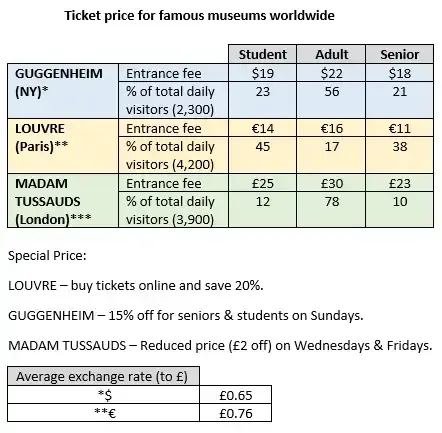
Question: How much did a family, visiting the Louvre, spend (in £) if it consisted of 3 adults, 2 students, and 1 senior, and 2 of the adults and 1 of the students bought their tickets online?
- A. £59.13
- B. £77.80
- C. £66.80
- D. £50.77
- E. £61.13
Choose your answer before looking at the explanation below.
The correct answer is A: £59.13
First, calculate the total cost in euros.
Student tickets:
- A student ticket costs €14.
- There are 2 students. One bought the ticket online and received a 20% discount.
- One student pays full price: €14
- One student pays 80% of €14: €14 × 0.8 = €11.20
Total for students: €14 + €11.20 = €25.20
Adult tickets:
- An adult ticket costs €16.
- There are 3 adults. Two bought their tickets online and received a 20% discount.
- One adult pays full price: €16
- Two adults pay 80% of €16: €16 × 0.8 = €12.80 each
Total for adults: €16 + €12.80 + €12.80 = €41.60
Senior ticket:
- A senior ticket costs €11.
- There is 1 senior.
- Total for senior: €11
The total cost in Euros: €25.20 + €41.60 + €11 = €77.80
The question asks for the total cost in GBP, so we convert using the exchange rate provided:
€77.80 × 0.76 = £59.13
⭐️ Golden Tip: You have about a minute per numerical question. Read the question first so you only pull out the figures you need.
What Is The Logiks General (Advanced) Abstract Reasoning Section?
The Logiks General (Advanced) Abstract Reasoning section assesses your ability to recognise patterns, analyse spatial information, and think critically under pressure.
You’ll be shown abstract images or sequences and asked to determine which option correctly completes the pattern.
This section contains 10 questions to be completed in 4 minutes, giving you less than 30 seconds per question. The challenge comes from both the complexity of the patterns and the tight time limit.
Success in the Logiks Advanced abstract reasoning section depends on spotting key patterns quickly, thinking logically under pressure, and avoiding distractions from misleading options.
Which block completes the following sequence:

Possible answers:
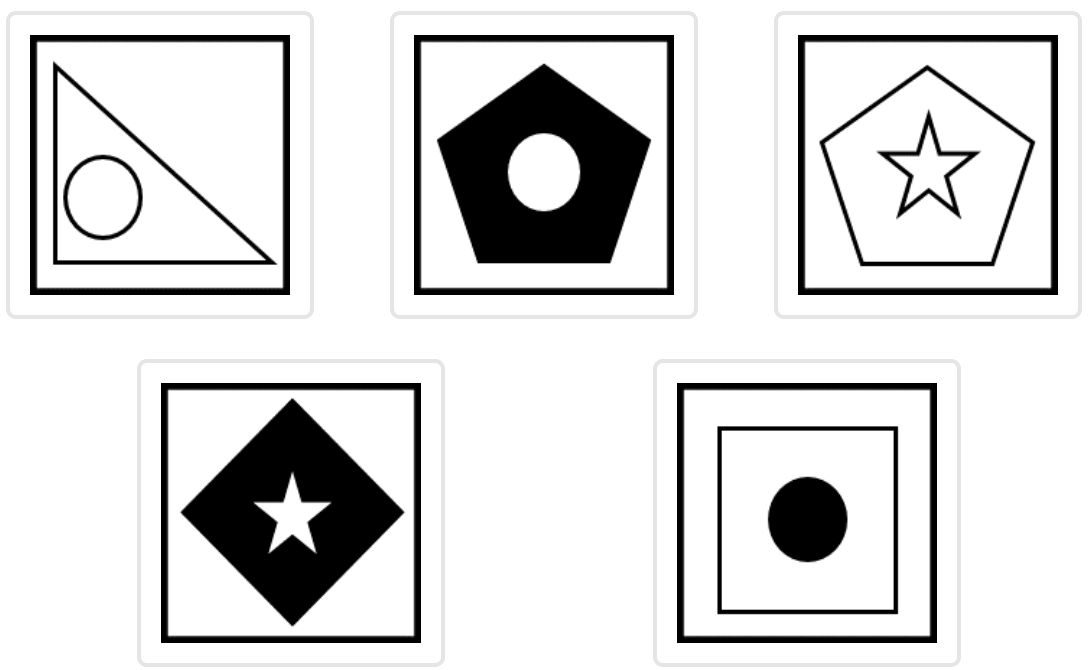
The correct answer is (3):

Explanation:
There are three rules in this question, but you only need to recognise two to reach the answer.
The inner figure alternates in each step between a black circle and a white star. This means the inner figure in the missing frame must be a white star, so you can rule out answers (1), (2), and (5).
To determine between answers (3) and (4), you only need to recognise one of these rules:
- The outer figure changes its shape in each step in this order: Square, pentagon, triangle, diamond. This means the outer figure in the missing frame must be a pentagon. The only answer that fits this pattern is (3).
- The outer figure changes its colour to black every two steps, so the outer figure in the missing frame must be white. The only answer that fits this pattern is (3).
Therefore, (3) is the only answer that fits.
⭐️ Golden Tip: You have under 30 seconds per abstract question, so you rarely need every rule. Our Logiks General (Advanced) PrepPack includes challenging abstract reasoning questions, timed drills, and proven techniques to help you recognise patterns faster and solve problems more efficiently.
While most candidates take the full Logiks General (Advanced) test covering all three parts, some employers administer standalone Logiks (Advanced) tests that focus on a single ability: Verbal (36 questions in 25 minutes), Numerical (20 questions in 25 minutes), or Abstract (30 questions in 15 minutes).
This format is designed for companies that want to assess only one aspect of your cognitive ability.
Grab Your Full Logiks Advanced PrepPack
Extra practice for Logiks Verbal (Advanced), Numerical (Advanced), and Abstract (Advanced), all in one PrepPack.
How To Pass The Logiks General (Advanced) Test
Follow these tips to maximise your chances of success on the Talogy Cubiks Logiks General (Advanced) test:
- Practise with realistic Logiks Advanced tests: Build confidence and speed using practice questions and full test simulations.
- Learn from your mistakes: Detailed answer explanations and test reports help you understand every question, improve weak areas, and master patterns.
- Pace each section differently: Verbal and numerical get 8 minutes each, but abstract gets only 4, so seconds disappear fastest there. Decide in advance how long each question deserves, and move on when it’s up.
- Plan multi-step questions before you calculate: Numerical questions give you about a minute each, and many need several steps, such as applying discounts and converting currencies. Write down the steps first, then calculate once.
- Practise switching between sections: The test moves between passages, data tables, and abstract patterns on a fixed clock, so practise all three back to back to keep your pace steady when the question type changes.
Our Talogy Logiks General (Advanced) PrepPack gives you realistic practice questions, timed simulations, and expert strategies to help you perform at your best on test day.
Master Your Cubiks Logiks General (Advanced) Test
Five full simulations, 34 section-specific practice sessions, and 17 guides and videos, with 1-week or 1-month access and a money-back guarantee.

Logiks General Advanced FAQs
Yes. Cubiks is now part of Talogy, so the Cubiks Logiks General (Advanced) test and the Talogy Logiks General (Advanced) test are the same assessment, just under a new name. Whichever name your invitation uses, the Advanced format is the same: 30 questions in 20 minutes. Read more about the company behind it all in our Talogy Assessment guide.
The Advanced test has 30 questions in 20 minutes, against 50 in 12 for the Intermediate test, so you get more time per question but each one asks more of you. Verbal moves from short word-based questions to passages, numerical from short calculations to tables, charts, and graphs, and abstract stays "next in series" with more rules changing at once, on the same under-30-seconds clock. Your invitation email will specify which version you’ve been assigned, and you’ll typically complete it online. See our Logiks General (Intermediate) page for that version.
There is no universal passing score. Results are reported as a percentile against a norm group of other candidates, so a result in the 75th percentile means you scored higher than 75% of that group, not that you answered 75% of the questions correctly. Your result reflects how accurately and, in some cases, how quickly you answer, and each employer sets its own standard for the role.
Logiks tests are generally not negatively marked, so unless your test instructions say otherwise, you should aim to answer every question, even if you need to make an educated guess when time is running out. Read more about marking and scoring on the Logiks test in our full Cubiks Logiks score guide.
Yes. Our PrepPack includes section-specific practice for verbal, numerical, and abstract, as well as full simulations, so you can strengthen one section before sitting the full test. This also suits you if an employer sets a standalone Logiks test.
Preparation time varies, but most candidates benefit from several days of focused, timed practice. Advanced questions are longer than Intermediate ones, so reviewing the explanation for each missed passage or multi-step data question matters as much as sitting more tests.
Our simulations are designed to reflect the real Talogy Cubiks Logiks General (Advanced) test: 30 questions in 20 minutes, with 12 verbal questions in 8 minutes, 8 numerical in 8 minutes, and 10 abstract in 4 minutes. They replicate the pressure of the timed assessment so you can practise pacing and strategy before the real exam.
No. The Intermediate test has a different format, with 50 shorter questions in 12 minutes, so the Advanced PrepPack isn’t the best way to practise for it. If you’re sitting the Intermediate test, see our Logiks General (Intermediate) PrepPack, or choose the Cubiks All-Inclusive PrepPack to cover both.
Yes. If you’re asked to sit the test again, for example, at a later hiring stage, the detailed explanations, performance tracking, and targeted drills help you understand previous mistakes and refine your strategy.
Both packs prepare you for the Logiks General (Advanced) test, but the All-Inclusive PrepPack gives you more practice for it. It also adds Logiks Intermediate tests, PAPI tests, and SJT practice tests, so it suits you if your process may include other Cubiks tests or you want extra practice on each section.
Why Trust JobTestPrep?
Founded by David Meshulam in 1992, JobTestPrep has over thirty years of experience helping candidates navigate competitive recruitment processes, including thousands preparing for Talogy assessments like Logiks General Advanced. With over 220 regularly-updated preparation courses and more than one million candidates supported worldwide, we offer professionally designed PrepPacks alongside advanced tools, including our AI-powered CV Analyser and Interview Prep platform. Together, these resources help candidates across the UK and beyond strengthen their applications and improve their performance.


More On Talogy & Cubiks
If you're preparing for Talogy and Cubiks assessments, you might find these other resources helpful:
- Talogy All-Inclusive PrepPack (Logiks, PAPI, and SJT)
- Talogy Logiks General (Intermediate) PrepPack
- Talogy PAPI PrepPack
- Talogy Caliper PrepPack
Also check out our Talogy assessments guide and our guide to understanding Cubiks test scores.


