Irish Civil Service: Your Guide To Aptitude Test Preparation (2026)
Updated: 9 September 2026
Working for the Irish Civil Service offers a prestigious and stable career in the public sector, with opportunities for career advancement, job security, and the chance to make a meaningful impact on public policy.
However, securing a position in the Civil Service can be highly competitive, as thousands of candidates apply for a limited number of roles each year. This makes preparation for the Irish Civil Service exams not just helpful, but often essential. Whether you’re aiming for an entry-level position like Executive Officer or a senior role such as Principal Officer, strong preparation for the recruitment process can significantly boost your chances of success.
Below, we'll guide you through everything you need to know about the Irish Civil Service recruitment process, the tests you’ll face, and how to prepare for them.

What Is The Irish Civil Service?
The Irish Civil Service is the backbone of Ireland’s government operations, responsible for implementing government policies, managing public services, and ensuring the effective delivery of programmes. It operates independently of political influence, with civil servants expected to perform their duties impartially.
The Civil Service in Ireland offers a wide range of roles, including:
- Clerical Officer (CO): The entry-level administrative grade, providing general clerical and administrative support across government departments and offices.
- Executive Officer (EO): A key administrative role that supports the implementation of government policies and public services.
- Administrative Officer (AO): Responsible for policy development, research, and managing projects.
- Higher Executive Officer (HEO): A supervisory position that oversees teams and implements strategic policies.
- Assistant Principal Officer (APO): A managerial position that focuses on overseeing large-scale projects and departments.
- Principal Officer (PO): A senior leadership role in charge of managing entire departments or divisions.
Additionally, there are opportunities to work in specialised government bodies like the Irish Prison Service, An Garda Síochána, Revenue Commissioners, and Third Secretary roles in the Department of Foreign Affairs.
The Irish Civil Service offers attractive salaries and a range of other benefits, including comprehensive pension schemes, annual leave, and job security. Due to the lucrative career opportunities, working for the Civil Service is highly desirable, making the recruitment process extremely competitive.
Prep For Popular Positions With Our PrepPacks
Get ready for popular Irish Civil Service positions, like EO and PO roles, with our designated, expert-led preparation packages. Don't forget to check out all our other preparation packages further down, too!
The Irish Civil Service Recruitment Process
The Irish Civil Service recruitment process is a competitive, multi-stage selection process managed by the Public Appointments Service (PAS).
Competitions are advertised and managed through publicjobs.ie, the official PAS platform. Candidates apply, receive test invitations, and track their application progress through their publicjobs candidate portal. If you're looking for publicjobs practice tests or want to understand the publicjobs assessment process, you'll find everything you need on this page and through our dedicated PrepPacks below.
The recruitment process is designed to evaluate key competencies such as communication, analysis, decision-making, and leadership, and applicants can expect to be assessed through a combination of online applications, aptitude tests, interviews, and, for some roles, assessment centre activities.
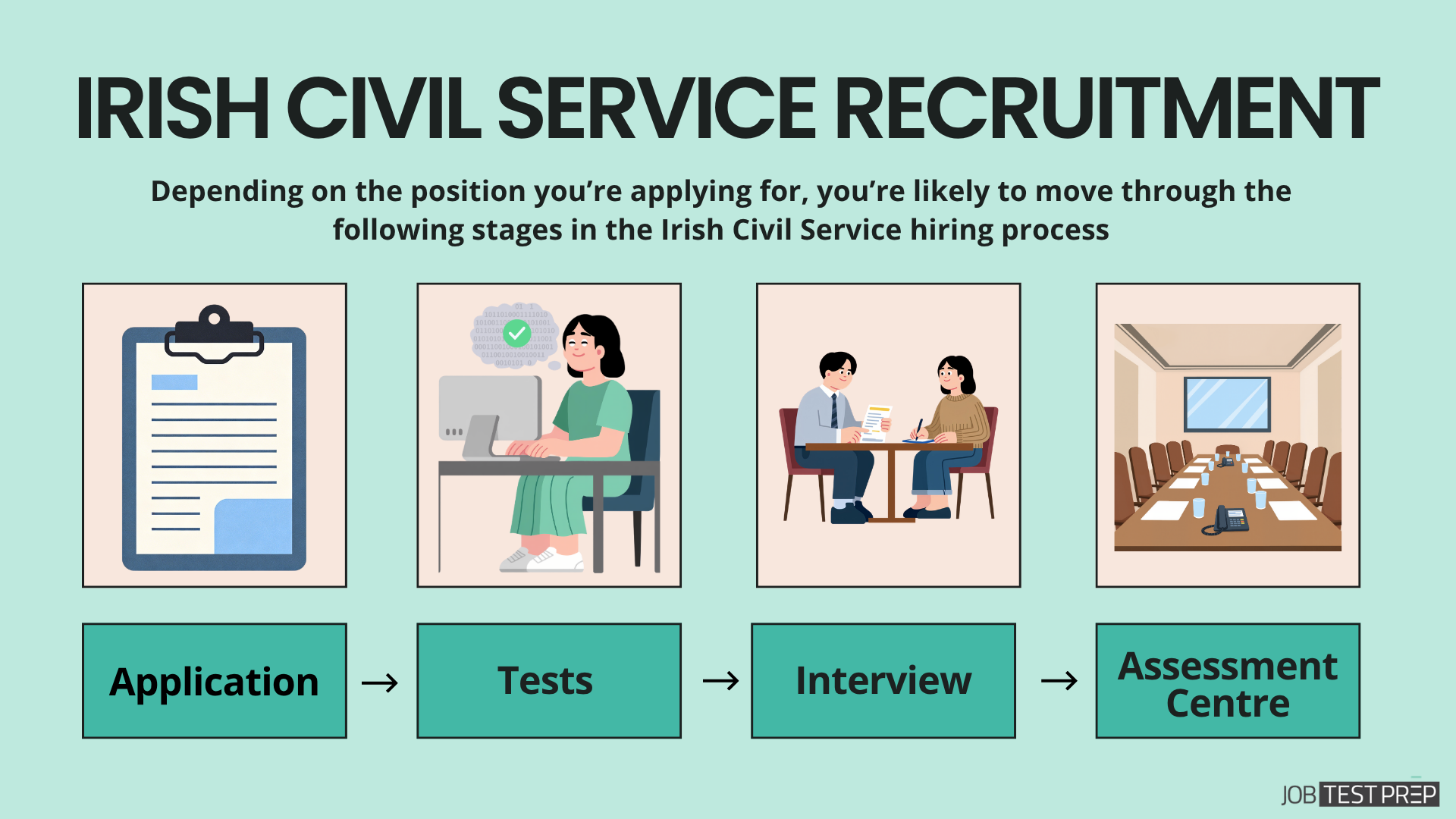
The typical Irish Civil Service hiring process includes:
- Application Forms & Self-Assessment Questionnaires: Candidates complete an online application outlining their personal details, qualifications, work experience, and competency-based examples. Screening or biodata questionnaires may also be used to shortlist applicants.
- Tests: Depending on the role, candidates may complete screening/biodata questionnaires, aptitude tests (verbal, numerical, and abstract reasoning), situational judgement tests, and, particularly for senior roles, critical analysis and job simulation tests. Additional assessments can include work sample exercises, presentations, role plays, and group exercises. For roles such as Administrative Officer or Principal Officer, testing may also assess leadership, strategic thinking, and project management skills.
- Interviews: Candidates typically progress to semi-structured (competency and situational), structured (competency-based), or video interviews. Some roles may also require presentations or case study responses.
- Staged Assessment Centres: For more senior or competitive roles, candidates attend an assessment centre involving group exercises, presentations, role plays, and additional interviews.
Successful candidates are typically placed on an order of merit panel, with job offers made as vacancies arise.
Top Tips To Pass Irish Civil Service Aptitude Tests
Preparing effectively for Irish Civil Service aptitude tests can significantly improve your chances of progressing through the recruitment process. The following tips will help you perform at your best:
- Practise under timed conditions: Most candidates struggle with time pressure rather than question difficulty. Simulating real test conditions helps build speed and confidence.
- Familiarise yourself with test formats: Understanding how verbal, numerical, and situational judgement tests are structured can prevent surprises on test day.
- Focus on accuracy as well as speed: Rushing can lead to avoidable mistakes. Aim for a balance between working quickly and answering correctly.
- Review your mistakes: Analysing incorrect answers helps identify patterns and improve performance over time.
- Use realistic practice materials: Preparing with test-style questions similar to those used in the Irish Civil Service can make a significant difference.
- Start early: Consistent practice over time is far more effective than last-minute preparation.
To help you get started, take a look at our PrepPack opportunities below.
Take A Closer Look At Our Irish Civil Service Prep Opportunities
The Irish Civil Service recruitment process can be daunting. But with the right tools (and the right practice), you’ll be ready to master the skills needed to ace your tests and land the job of your dreams.
Our PrepPacks are expertly created and tailored to help you prepare for the real Irish Civil Service tests, simulating the actual conditions you’ll face during the recruitment process.
Check out all our Irish Civil Service preparation opportunities:
- Clerical Officer Test PrepPack
- Executive Officer Test PrepPack
- Administrator Officer Test PrepPack
- Higher Executive Officer Test PrepPack
- Irish Prison Service Officer Test PrepPack
- An Garda Síochána Trainee Test PrepPack
- Assistant Principal Officer Test PrepPack
- Principal Officer Test PrepPack
- Third Secretary Test PrepPack
With our targeted preparation packs, you’ll be equipped to tackle everything from verbal reasoning and numerical reasoning tests to job simulations and critical analysis exercises. These packs are designed to give you the confidence and knowledge needed to succeed at each stage of the recruitment process.
Ace Your Irish Civil Service Principal Officer Test
A lucrative career in the Irish Civil Service could only be one assessment away: Get ready with our expert-created Principal Officer PrepPack and approach your test with confidence.

FAQs
While the recruitment processes across the Irish, Northern Irish, and UK Civil Services share many similarities, there are some important distinctions candidates should be aware of.
The Irish Civil Service recruitment process is managed by the Public Appointments Service (PAS) and typically involves online applications, aptitude tests (verbal, numerical, and situational judgement), interviews, and assessment centres. Competitions often result in candidates being placed on an order of merit panel, with roles offered as vacancies arise across government departments in Ireland.
The Northern Ireland Civil Service (NICS) follows a similar structured process, including aptitude tests, competency-based interviews, and assessment exercises. However, recruitment is conducted under NICS-specific frameworks, and the exact tests and competencies assessed may differ depending on the role. For example, candidates applying for roles such as Grade 7 will follow a process tailored to NICS requirements, which may include slightly different assessment formats or criteria.
The UK Civil Service recruitment process is also competency-based but is guided by the Success Profiles framework, which assesses candidates across behaviours, strengths, ability, experience, and technical skills. In addition to standard aptitude tests (such as verbal understanding and numerical reasoning), UK Civil Service roles may place greater emphasis on strength-based interviews and blended assessments.
While all three systems use psychometric testing, interviews, and assessment centres, the structure, frameworks, and specific assessments can vary. Candidates should ideally prepare using materials tailored to the specific Civil Service they are applying for, but even general aptitude test practice is far better than no preparation at all, and can significantly improve performance across all stages of the process.
The recruitment process can take several months from application to final offer. In some cases, candidates are placed on a panel that remains active for one to two years, with job offers made as vacancies arise.
Yes. Candidates can be eliminated at any stage of the process, including application screening, aptitude tests, or interviews. Progression is competitive and based on performance relative to other candidates.
Irish Civil Service aptitude tests are designed to assess cognitive ability, problem-solving, and decision-making skills. The most common tests include verbal reasoning (understanding and interpreting written information), numerical reasoning (working with data and numbers), and situational judgement tests (SJT), which evaluate how you respond to realistic workplace scenarios. For senior roles, additional assessments such as critical analysis or job simulations may also be used.
The tests are designed to be challenging due to time pressure and competition rather than complexity. Many candidates find them difficult without preparation, but practising test-style questions can significantly improve performance. This is precisely where our JobTestPrep preparation packages come in!
Preparation typically involves practising verbal, numerical, and situational judgement tests under timed conditions. Many candidates use online practice platforms and role-specific preparation packs (e.g. our JobTestPrep Executive Officer or Principal Officer PrepPacks) to familiarise themselves with the format of the tests, improve speed and accuracy, and understand how answers are scored.
There is usually no fixed pass mark. Candidates are ranked based on their performance, and only the highest-scoring applicants progress to the next stage. The cut-off score can vary depending on the competition and number of applicants.
Exact questions are unlikely to repeat, but the format and style of questions are very consistent. Practising similar question types can help you become familiar with the structure and improve your performance.
A personality assessment evaluates a candidate’s behavioural traits, working style, and suitability for a specific role. It's usually used as a supplementary assessment tool and may be presented to interview panels in report form or as a summary profile. The results help employers understand how a candidate is likely to behave in a professional environment, particularly in areas such as teamwork, leadership, and decision-making.
Group exercises are used to assess interpersonal, communication, and leadership skills. Candidates are evaluated on their ability to contribute to discussions, influence others, negotiate, and manage relationships, as well as demonstrate assertiveness and teamwork.
There are typically two types of group exercises used during the Irish Civil Service recruitment process. In a non-assigned role exercise, candidates work together without specific roles, allowing assessors to observe natural behaviour and collaboration. In an assigned role exercise, candidates are given specific roles or positions, often competing for the same job, which introduces a more competitive dynamic and tests persuasion, decision-making, and role-specific behaviour.
You can find Irish Civil Service practice questions through online practice platforms like JobTestPrep and preparation packs designed for Civil Service exams. These typically include practice questions and mock tests for verbal reasoning, numerical reasoning, and situational judgement tests, helping you become familiar with the format and improve your performance. Using realistic Irish Civil Service sample questions is one of the most effective ways to prepare for the assessment stages.