 Irish Civil Service Third Secretary Online Assessment Preparation (2026)
Last updated: 9 September 2026 | Trusted by thousands worldwide.
The Third Secretary is the entry-level grade of Ireland's diplomatic service, based in the Department of Foreign Affairs and Trade. It's a demanding and prestigious role that combines policy analysis, stakeholder liaison, and frontline consular work, with a strong likelihood of postings abroad throughout your career.
The selection process is highly competitive and designed to assess verbal reasoning, numerical reasoning, and situational judgement across multiple stages. That's why preparation isn't just helpful - it's essential.
Our exclusive Irish Civil Service Third Secretary PrepPack gives you everything you need to ace the online assessments, with targeted practice for verbal reasoning, numerical reasoning, and situational judgement.
Third Secretary Online Assessment
 1-MonthAccess
 Realistic practice tests & study guides
 Created by experts with a focus on accuracy
What's Included:
- 10 SOVA-Style Verbal Reasoning Simulations
- 14 Additional Verbal Reasoning Practice Tests
- 3 SOVA-Style Numerical Reasoning Simulations
- 11 Additional Numerical Reasoning Practice Tests
- 3 SOVA-Style Situational Judgement Test (SJT) Simulations
- 16 Additional SJT Practice Tests
- 4 Logical Thinking Practice Tests
- 14 Expert-Designed Study Guides & Video Tutorials

Inside Our Third Secretary PrepPack
To ensure you're fully prepared, our Third Secretary PrepPack includes everything you need to succeed in the online assessments, with targeted practice for both the SOVA-delivered assessments and additional AON-style preparation.
- 24 Verbal Reasoning Simulations & Practice Tests: Build speed and accuracy with 10 verbal reasoning simulations and 14 additional practice tests, all in the True/False/Cannot Say format.
- 14 Numerical Reasoning Simulations & Practice Tests: Sharpen your ability to interpret tables and charts under pressure with 3 numerical simulations and 11 additional practice tests.
- 19 Situational Judgement Simulations & Extra Practice Tests: Develop your judgement and decision-making with 3 SJT simulations reflecting the real Third Secretary assessment format, plus 16 additional practice questions.
- 4 Logical Thinking Practice Tests: Additional logical thinking practice to further strengthen your overall cognitive performance ahead of the assessments.
- 14 In-Depth Study Guides & Video Tutorials: Benefit from 10 expert study guides and 4 video tutorials covering verbal reasoning, numerical reasoning, and situational judgement strategies, giving you the knowledge and confidence to approach every section with clarity.
With realistic simulations, expert study guides, and video tutorials across every section, our JobTestPrep Third Secretary PrepPack gives you the knowledge, practice, and confidence to perform at your best when it matters most.
Ace Your Third Secretary Assessment
Get everything you need to succeed with 40+ practice tests, expert study guides, and video tutorials, designed to reflect the real assessments.
What Is The Third Secretary Online Assessment?
The Third Secretary online assessment is used during the recruitment process to determine whether candidates have what it takes to analyse complex information, interpret data under pressure, and make sound judgements in demanding diplomatic scenarios.
It consists of three components: a verbal reasoning test, a numerical reasoning test, and a situational judgement test tailored specifically to the Third Secretary role.
Let's explore each part of the assessment in more detail.
The online assessments are typically the first stage of the Third Secretary selection process, but candidates who perform well can expect to be invited to further stages, which have previously included a video interview and assessment centre activities.
The interview stage is where candidates get the opportunity to bring their application to life. It's a chance to demonstrate the resourcefulness, organisational ability, and flexibility that the role demands.
Like any competitive interview, preparation makes a significant difference.
The Public Appointments Service recommends that candidates:
- Research the Department of Foreign Affairs and Trade and understand its work
- Familiarise themselves with the skills and qualities required for the Third Secretary role
- Reflect on their own strengths and how these align with the role
- Prepare concrete examples and experiences that demonstrate relevant competencies
- Consider why their background makes them a strong candidate
- Practice their answers with a friend or colleague to build confidence
As with the online assessments, the exact format and stages of the process can vary between competitions, and it's worth checking your Competition Information Booklet for the most up-to-date information on what to expect.
⭐️Good to Know: The Third Secretary assessments have not always used the same test provider. Earlier competitions used AON's Assessment Solutions (formerly known as Cut-e), while more recent competitions have moved to the SOVA Assessment platform. Our PrepPack includes practice material for both, so you're covered regardless of which format you encounter. For candidates progressing to later stages, we also offer an AI-Driven Interview Prep tool as an add-on, designed to help you practise and refine your interview technique.
Get Full Third Secretary Prep
Our PrepPack includes SOVA-style and AON practice materials, as well as additional practice drills, study guides, and video tutorials, so you're prepared no matter what comes your way.
What Is A Development Specialist Officer (DSO)?
Recruited alongside the Third Secretary in the same competition, the Development Specialist Officer is a related but distinct role within the Department of Foreign Affairs and Trade.
Where the Third Secretary is a generalist diplomatic role, the DSO is more technical in nature, focused on providing specialist support for Ireland's international development programmes, most notably Irish Aid, the Government's overseas development initiative.
Day-to-day responsibilities include supporting the implementation of development programmes, liaising with embassies and missions abroad, and contributing to Ireland's broader foreign policy objectives in areas such as humanitarian assistance and sustainable development. Like the Third Secretary, the role involves travel and extended periods working abroad across Ireland's global network of missions.
Importantly for candidates, both roles share the same Stage 1 online assessments, meaning our Third Secretary PrepPack is equally relevant preparation whether you're applying for the Third Secretary or Development Specialist Officer position.
What Skills Do You Need to Become A Third Secretary?
The Ireland Third Secretary role is open to graduates of all disciplines, but the selection process is designed to identify candidates with a specific set of qualities that go beyond academic achievement.
To succeed in the competition - and in the role itself - candidates should be able to demonstrate the following:
- Analytical ability: Third Secretaries are expected to produce thorough evaluations of complex situations and translate them into clear, actionable recommendations. Strong reading comprehension and numerical literacy are essential.
- Communication and collaboration: From drafting briefing material for Ministers to liaising with embassies and government departments, the role demands clear, precise, and professional communication at all levels.
- Adaptability and resilience: With postings to diverse locations around the world, including challenging regions, candidates must be comfortable working in unfamiliar environments and navigating unexpected situations with composure.
- Commitment to foreign languages: While fluency in a second language is not always a formal requirement, a willingness to learn and work in foreign languages is considered a significant asset throughout a diplomatic career.
- Organisational ability: Third Secretaries manage a wide range of responsibilities simultaneously, from budget oversight to high-level diplomatic visits, making strong organisational skills a must.
The good news is that many of these skills are directly assessed in the Stage 1 online assessments, making thorough preparation not just useful for passing the test, but genuinely reflective of what the role demands.
What Is The Third Secretary Capability Framework?
The Third Secretary Capability Framework is the set of core competencies that underpins the entire selection process, from the online assessments to the interview stages. It defines the behaviours, skills, and qualities that candidates are expected to demonstrate in the role, and it informs how candidates are assessed at every stage of the competition.
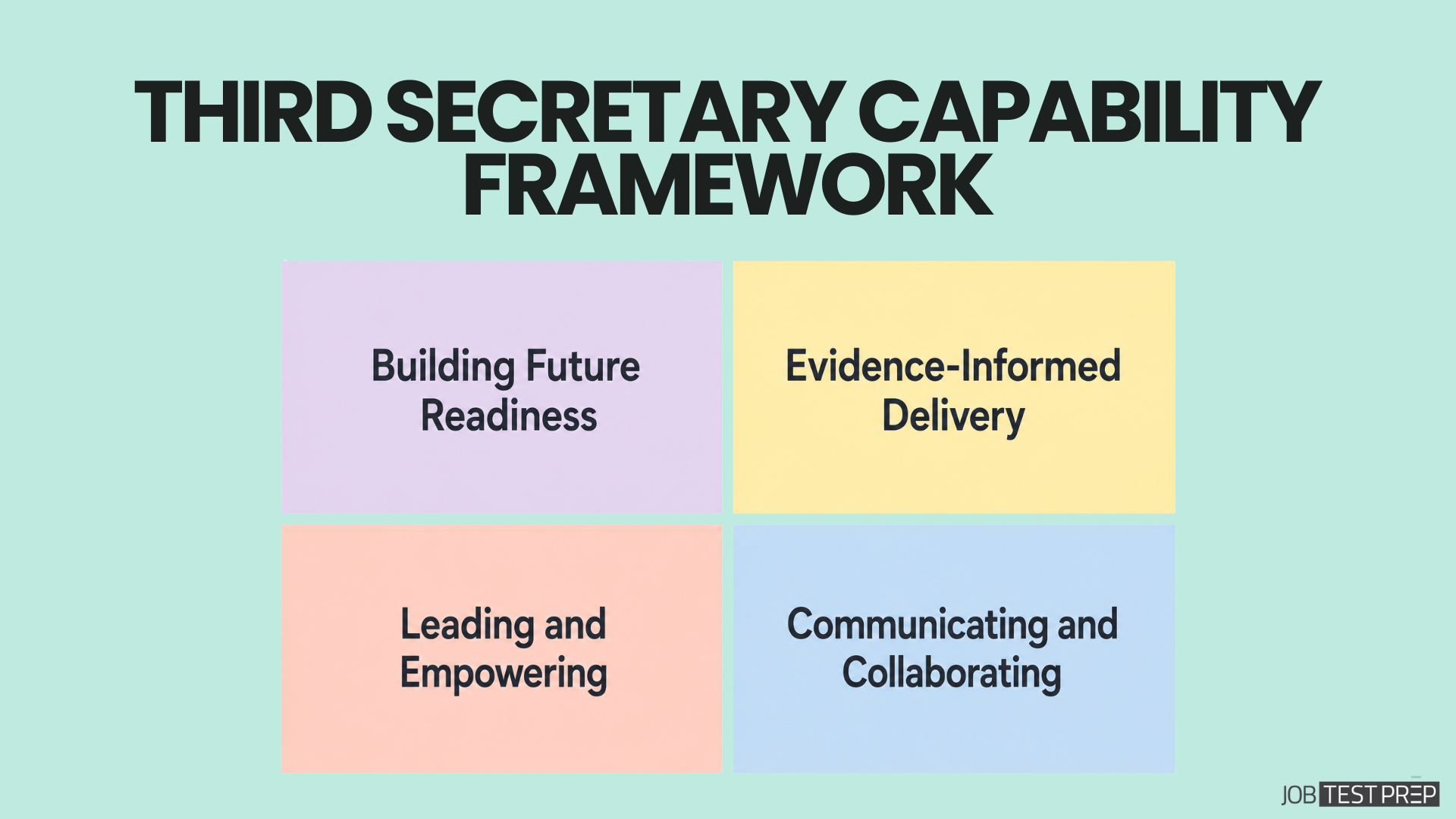
The framework is built around four capability dimensions:
- Building Future Readiness: The ability to embrace change, adopt new approaches, and continuously develop skills to meet the evolving demands of a modern diplomatic service. This includes digital literacy, openness to innovation, and a commitment to ongoing learning.
- Evidence-Informed Delivery: The ability to gather, analyse, and interpret information to make well-reasoned judgements and deliver high-quality outcomes. This is directly reflected in the verbal and numerical reasoning assessments at Stage 1.
- Leading & Empowering: The ability to take initiative, support colleagues, and contribute positively to a team, even at an early career stage. Third Secretaries are expected to show leadership potential from the outset.
- Communicating & Collaborating: The ability to communicate clearly and professionally across a wide range of audiences and contexts, and to build effective working relationships with colleagues, stakeholders, and foreign counterparts.
Understanding the Capability Framework is valuable not just for the assessments, but for every stage of the Third Secretary competition. Candidates who familiarise themselves with these four dimensions will be better placed to demonstrate the right behaviours throughout the process.
How To Prepare For The Third Secretary Competition
The Third Secretary competition is one of the most competitive in the Irish Civil Service, with thousands of candidates vying for a small number of places.
Preparation is what separates successful candidates from the rest, and it starts well before the assessment window opens.
- Know the role: Familiarise yourself with the work of the Department of Foreign Affairs and Trade, the responsibilities of a Third Secretary, and the four dimensions of the Capability Framework. The more clearly you understand what the role demands, the better equipped you'll be to demonstrate it throughout the process.
- Practice the assessments: The Stage 1 online assessments are the first and most significant hurdle. Verbal reasoning, numerical reasoning, and situational judgement are all practicable skills that improve meaningfully with targeted preparation. Candidates who practise under realistic conditions consistently perform better than those who go in cold.
- Work on speed and accuracy: Both the verbal and numerical reasoning assessments record your response time alongside your accuracy. Getting comfortable working quickly and confidently under pressure is essential.
- Prepare for the interview: Candidates who progress beyond Stage 1 will face further assessment stages, including an interview. Prepare concrete examples from your own experience that demonstrate the four capability dimensions, and practise articulating them clearly and concisely.
Our Irish Civil Service Third Secretary PrepPack is designed to give you the best possible preparation for the online assessments, with realistic practice tests for verbal reasoning, numerical reasoning, and situational judgement, detailed answer explanations, and expert guidance to help you perform at your best when it matters most.
Don't Leave Your Third Secretary Preparation to Chance
With thousands of candidates competing for a small number of places, preparation is what sets successful candidates apart. Get instant access to targeted practice tests across all three assessments and give yourself the best possible chance.

Irish Civil Service Third Secretary FAQs
A Third Secretary in Ireland's Department of Foreign Affairs and Trade is an entry-level diplomat responsible for a broad range of functions. These include conducting analysis and research, organising and reporting on meetings, liaising with embassies, consulates, and government agencies, and ensuring the continuity of consular services for Irish citizens abroad.
The Third Secretary role is paid on a Civil Service salary scale, with starting salaries generally in the low-to-mid €30,000s, rising incrementally with experience and progression.
The Third Secretary selection process is run by the Public Appointments Service (PAS) and typically takes place across several stages, though the exact structure can vary between competitions.
Most competitions begin with an online application form, where candidates provide details of their experience and qualifications. Shortlisted candidates are then invited to complete online psychometric assessments, which generally include verbal reasoning, numerical reasoning, and a situational judgement test (SJT) tailored to the Third Secretary role.
Candidates who progress may then be invited to a video interview, before the final stage, an assessment centre, which can include written exercises, group tasks, and competency-based interviews.
Not all stages appear in every competition, and the order or format may differ.
The full process for any given competition will be outlined in the Competition Information Booklet, published on publicjobs.ie when the role is advertised.
One of the most distinctive aspects of the Third Secretary role is the expectation to serve abroad. Postings to Irish embassies, consulates, and missions are a core part of a diplomatic career, with Third Secretaries typically dividing their time between department headquarters in Dublin and postings abroad, often rotating every few years.
Ireland's diplomatic network has grown significantly in recent years, with more than 90 missions across over 70 countries worldwide, and that number continues to grow. As a Third Secretary, you could find yourself posted anywhere from major world capitals to smaller, more challenging regions, representing Ireland's interests across a remarkably broad range of contexts.
The scope of the work abroad is equally varied. Responsibilities can range from organising high-level government visits and promoting Irish trade and investment, to managing mission budgets, supporting development programmes, and providing consular assistance to Irish citizens in difficulty.
For this reason, the department looks for candidates who are not just academically capable, but genuinely adaptable, resilient, and open to building a career that takes them across the globe.
The Third Secretary online assessments are widely considered to be among the more demanding in the Irish Civil Service. The verbal and numerical reasoning tests use adaptive technology, meaning the difficulty adjusts in real time based on your performance, and both speed and accuracy contribute to your score. The situational judgement test adds a further layer of complexity, requiring candidates to make nuanced judgements across diplomatic scenarios under a strict time limit. With thousands of candidates competing for a small number of places, the standard is high, and preparation makes a significant difference.
The Third Secretary competition doesn't run on a fixed annual cycle. It's typically advertised every few years, depending on the staffing needs of the Department of Foreign Affairs and Trade. Competitions were held in 2018, 2022, 2024, and 2026, suggesting an increasing frequency in recent years as Ireland's diplomatic network continues to expand.
The Third Secretary competition is open to graduates of all disciplines, provided they hold a degree at Level 7 or above on the National Framework of Qualifications. Candidates must also be citizens of the EU or have the right to work in Ireland, and must be prepared to accept postings abroad as a condition of service. Specific eligibility requirements can vary between competitions, so candidates should always refer to the Competition Information Booklet for the exact criteria.
Third Secretary is the entry grade of Ireland's diplomatic service and the first step on a long-term career path within the Department of Foreign Affairs and Trade. With experience and strong performance, Third Secretaries can progress to First Secretary, then Counsellor, and ultimately to senior roles including Ambassador and Permanent Representative to international bodies such as the United Nations and the European Union. It's one of the few roles in the Irish Civil Service that offers a genuinely international career trajectory from the very first day.
Customer reviews
4.7
★
★
★
★
★
Based on 118 reviews
Very thorough and lots of practice material to help getting ready for the exams
Helpful for preparing for the assessments.
Great content
The tests were quite accurate to the real ones, and helped me in my preparation.
Great
...
Who Are We?
JobTestPrep has been at the forefront of assessment preparation since 1992. Founded by David Meshulam, we've spent over 30 years earning the trust of candidates and establishing ourselves as a leading name in psychometric test prep. Our materials are crafted by specialist practitioners and kept up to date through ongoing candidate feedback, so they always reflect real, current test formats. Across more than 220 courses and over a million successful candidates, we combine expert-developed PrepPacks with AI-powered tools, including a CV analyser and Interview Prep platform, to support job seekers at every stage.


More On Civil Service Ireland
If you're preparing for Irish Civil Service tests, you might find these other resources helpful:
- Clerical Officer Test PrepPack
- Executive Officer Test PrepPack
- Higher Executive Officer Test PrepPack
- Administrator Officer Test PrepPack
- Assistant Principal Officer Test PrepPack
- Principal Officer Test PrepPack
- Irish Prison Service Test PrepPack
- An Garda Síochána Test PrepPack
Also visit our Irish Civil Service guide for more information on Civil Service Ireland competitions, roles, and recruitment processes.
If you're interested in Northern Ireland preparation opportunities, check out our NICS Recruitment Guide and our NICS Grade 7 PrepPack.


