 Civil Service Fast Stream UK Guide (2026)
Last updated: 7 October 2026 | Trusted by thousands worldwide.
The Civil Service Fast Stream is a prestigious UK graduate programme designed to develop the next generation of leaders in the Civil Service.
Renowned for its rigorous selection process, the programme fast-tracks participants into leadership roles across government departments, providing invaluable experience and opportunities to shape public policy. Due to its highly competitive nature, only around 1.0% of candidates get to the end, making thorough preparation crucial for those seeking to join.
This guide offers a comprehensive overview of the Civil Service Fast Stream, covering the application process, key stages, and tips to help you succeed in the selection process.
Applications for 2027 entry open at midday on 8 October 2026 and close at midday on 5 November 2026.
Applications for 2027 entry open at midday on 8 October 2026 and close at midday on 5 November 2026. Our comprehensive PrepPack gives you the best chance of success.

What Is The Civil Service Fast Stream?
The Civil Service Fast Stream is an elite development programme that fast-tracks graduates into leadership roles within the UK Civil Service.
Participants, known as Fast Streamers, are placed in one of 18 specialised schemes, each targeting a specific profession or area of expertise, such as policy-making, digital services, and operational delivery.
Over the course of the programme, they rotate through various placements within their chosen scheme, gaining comprehensive experience across different government functions. That range is deliberate, as it's what prepares participants to take on genuine leadership responsibility by the time they finish.
The UK Fast Stream is renowned for its rigorous selection process, focusing on key competencies like leadership, communication, and problem-solving, but it provides a unique opportunity for graduates to quickly develop their leadership skills and influence public policy and service delivery.
The Civil Service Fast Stream Application Process
The application process for the Civil Service Fast Stream is structured across several stages, each designed to assess your suitability for the programme.
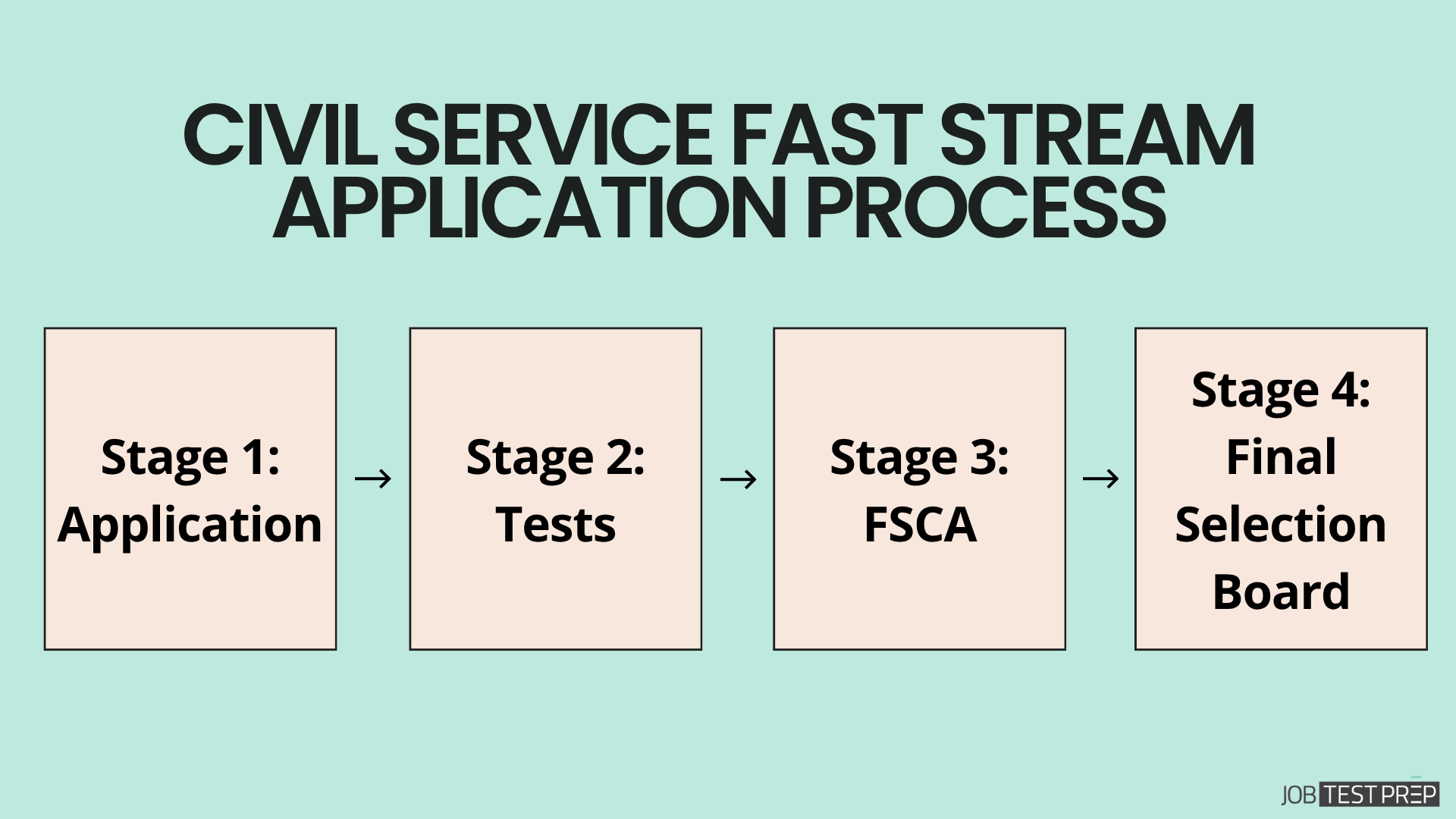
The process uses a variety of assessment formats, such as video, written exercises, and scenario-based activities, each mirroring the kind of real-world tasks you'd handle on the job.
Stage 1: Online Application
The first stage involves completing an online application form where you'll provide your personal information and academic background, and answer diversity questions for monitoring purposes.
You’ll also have the opportunity to select up to 3 schemes that match your interests.
Different schemes have different eligibility criteria, so it's worth checking you meet the requirements of the ones you're interested in.
Ensure you use a personal email address to complete your application, as work or university emails may not be accepted. Official Fast Stream documentation recommends a Gmail account, as you'll need a Google account to complete the onboarding if your application is successful.
Stage 2: Online Tests (Work-Based Scenarios & Case Study)
The second stage consists of two untimed online assessments:
- Work-Based Scenarios: You'll watch short videos of 12 work situations and rate how effective different possible actions would be.
- Case Study: An evolving scenario where you play an imaginary role, review 7 pieces of background information, and then respond to 24 situations. In some you identify the most and least effective responses, while, in others, you rate the effectiveness of several actions.
The Work-Based Scenarios measure interpersonal skills, while the Case Study assesses your decision-making and your ability to adapt to changing circumstances. You’ll have a 7-day window to complete both tests.
Head to our Civil Service Fast Stream Online Tests PrepPack & Guide for more information on this stage of the application process.
Prep For Civil Service Fast Stream
Get all the preparation you need for the Civil Service Fast Stream Online Tests with our expert-created Fast Stream PrepPack.
Some Schemes: Additional Information Stage
After the online tests, some schemes ask for additional information to go alongside your application, which may include motivational questions or academic details. If this applies to you, you'll have 7 days to complete the requested sections, so keep an eye on your applicant homepage to see if a new section has been added.
The Fast Stream aims to assess additional information within 2 weeks of submission. All information is anonymised before it's reviewed, so individual feedback isn't provided at this stage.
Stage 3: Civil Service Fast Stream Assessment Centre (FSAC)
If you successfully pass the previous stages, you'll be invited to a virtual Civil Service Fast Stream Assessment Centre (FSAC). This typically lasts half a day and includes the following exercises to be completed remotely on a virtual assessment platform:
- Written Exercise: You'll play the role of a Fast Streamer overseeing a project, reviewing information and completing 5 written tasks in 55 minutes.
- Oral Briefing Exercise: You'll analyse data and brief a director, played by an assessor, on your findings. You get 45 minutes to prepare, followed by a 25-minute meeting.
- Personal Development Conversation: A 30-minute one-to-one discussion about your strengths, motivations, and your interest in the Fast Stream and the Civil Service.
These exercises may share a common theme but they're separate tasks and each is marked independently by a different assessor. The FSAC is designed to simulate the types of challenges you may face as a Fast Streamer, testing your leadership potential, communication abilities, and problem-solving skills.
Head to our Civil Service Fast Stream Assessment Centre PrepPack & Guide for more information on this stage of the application process.
Prep For Civil Service Fast Stream Assessment
Our preparation package for the Fast Stream Assessment Centre will ensure you're ready for whatever is thrown your way.
Stage 4: Final Selection Board (If Required)
For most schemes, the final stage involves the Final Selection Board (FSB). However, the Government Policy, Cyber Security, and Digital Fast Stream schemes end their selection process at FSAC and don't require this final stage.
If you're successful at the FSAC for a scheme with an FSB, you'll take a specialist assessment testing the skills and strengths specific to your chosen scheme. Details will be in the FSB guide linked in your invitation.
Assessment centres run from November to February, and your feedback report will be available on your Fast Stream homepage, regardless of whether or not you're successful.
⭐️ Previous Application Process: In the past, the Civil Service Fast Stream application process included several stages that have since evolved. Previously, candidates would complete an e-tray exercise, reviewing emails and tasks to prioritise and respond as they would in the role. Video interviews were also part of earlier cycles, designed to assess how candidates answered competency-based questions, but these have been replaced by the current online tests. Applicants also used to be able to select up to 4 schemes, while the current limit is now 3 schemes.
Stage 5: What Happens After You're Accepted
Once you've passed all the stages, from the online tests through to the assessment centre and, where applicable, the final selection board, there's still a gap before you actually start.
Fast Stream schemes typically begin in September or October the year after you apply, depending on your scheme.
This means successful candidates usually have several months between hearing the good news and their first day. It's worth using this time productively: Many Fast Streamers use the gap to travel, finish up other commitments, or simply prepare for the transition into a demanding new role.
What Are The Civil Service Fast Stream Schemes?
The Civil Service Fast Stream offers 18 specialised schemes across a range of professions, each designed to develop future leaders in specific areas of government and public service. These schemes cover a broad spectrum of roles, from policy and social research to digital services, technology, and operational delivery.
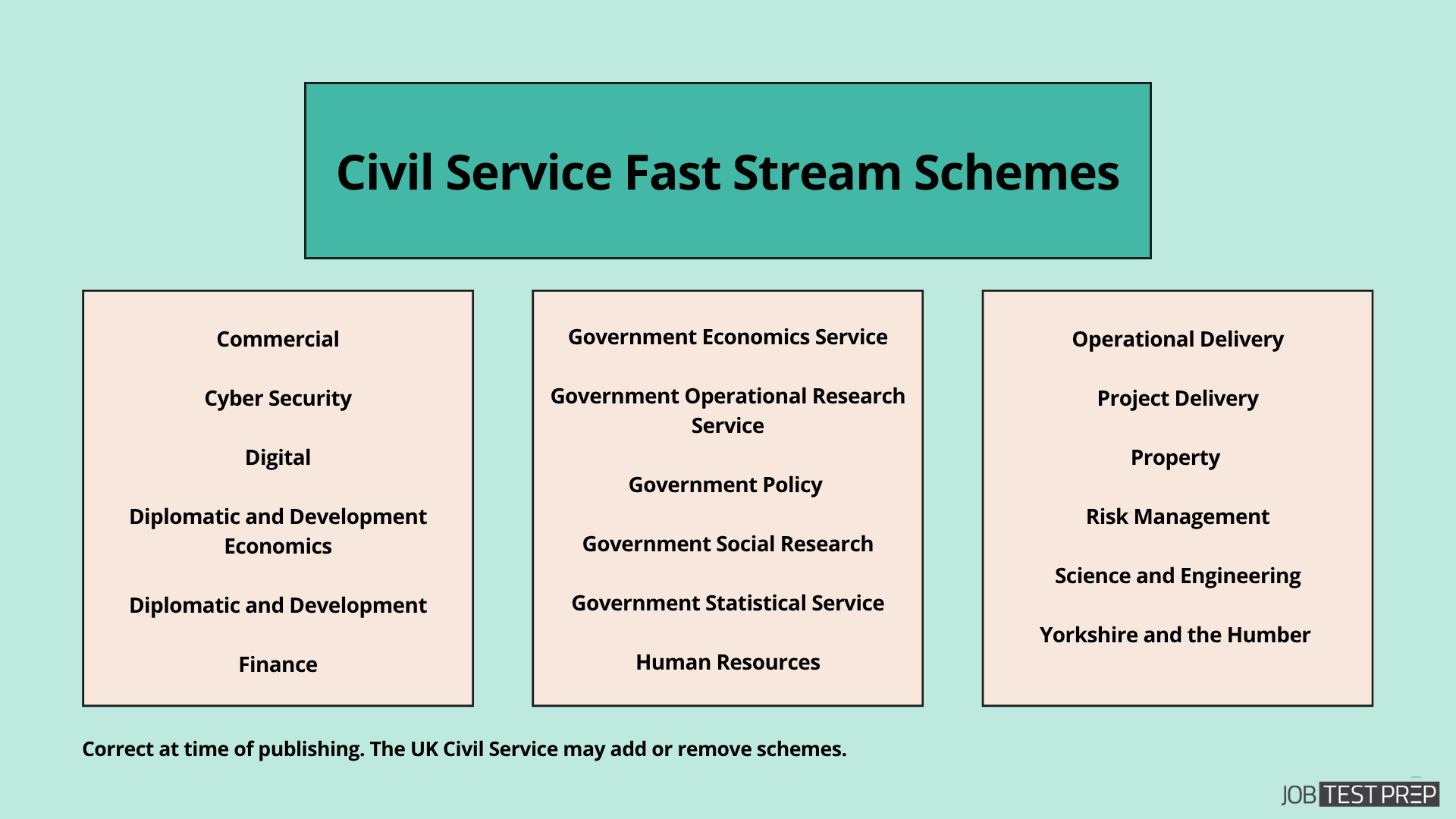
As a Fast Streamer, you’ll have the opportunity to work in different government departments, gaining hands-on experience across a range of real projects.
Each scheme offers a tailored development path in its specific profession. Some schemes require specialised knowledge, such as in Science and Engineering, while others focus on broader roles in HR, Finance, or Government Policy.
For more detailed information on each scheme, including what they entail, the skills required, and career opportunities, visit the official UK Civil Service Fast Stream Schemes guide.
What Is The Civil Service Summer Internship Programme (SIP)?
The Civil Service Summer Internship Programme (SIP) is a paid summer placement that offers undergraduates from lower socio-economic backgrounds the opportunity to gain hands-on experience within a government department. This immersive programme allows participants to work on meaningful projects, contribute to policy development, and gain a unique insight into the workings of the UK Civil Service.
The internship is designed for undergraduate students in their final two years of study who are interested in pursuing a career in public service. It provides an excellent introduction to the Civil Service, helping you develop key skills and build a professional network that'll benefit you throughout your career.
A standout feature of the SIP is the Fast Stream Fast Pass. If you receive positive feedback during the internship, you may be offered the opportunity to fast-track through the initial stages of the Civil Service Fast Stream application process, if you apply within 12 months. This means you’ll bypass some of the earlier assessments, helping you progress more quickly to the assessment centre.
Civil Service Fast Stream Success Rate: How Competitive Is It?
The Civil Service Fast Stream success rate is famously low, making it one of the most competitive graduate programmes in the UK. Across all schemes in the most recent published recruitment data, only about 1.0 % of applicants were recommended for appointment, meaning roughly 1 in every 100 applicants receives an offer.
Several factors contribute to this competitiveness:
- High volume of applicants: Popularity among graduates from a wide range of academic and professional backgrounds consistently drives up the number of applicants, increasing competition for a limited number of places.
- Selective assessments: The application stages are designed to assess a broad range of Success Profile elements, alongside leadership competencies, decision‑making abilities, and real‑world judgement, meaning candidates must perform well across multiple formats.
- Scheme variation: Some schemes are more competitive than others. For example, specialised professional pathways such as Diplomatic‑focused streams tend to have lower success rates than broader schemes with larger annual intakes.
For perspective, most UK graduate schemes have success rates much higher than this. Many receive far fewer applications, and typical acceptance rates are significantly above 5 - 10 % for standard employer graduate programmes (though direct comparisons vary by sector and year).
How To Prepare For The UK Civil Service Fast Stream
Since the Civil Service Fast Stream is highly competitive, thorough preparation makes a real difference. Here are some key tips to help you perform your best:
- Understand what's actually being assessed: At the Assessment Centre, you're assessed against the 4D framework: Think, Relate, Adapt, and Strive. Review each dimension and think about how your own experiences map onto it.
- Practise for the online tests: The online assessments, including the Work-Based Scenarios and Case Study, are designed to test your problem-solving and decision-making abilities. Taking practice tests can help you become familiar with the format and sharpen your analytical skills.
- Prepare for the FSAC: The Fast Stream Assessment Centre (FSAC) is a critical stage, and you’ll need to demonstrate your leadership, communication, and self-awareness across three exercises, the Written Exercise, the Oral Briefing Exercise, and the Personal Development Conversation. Practising similar exercises will help you feel more confident.
- Stay organised and plan your time: With multiple stages to the process, it’s essential to stay organised. Set aside dedicated time to complete the application and tests, and allow for extra preparation for the FSAC.
- Research the schemes: Familiarise yourself with the different Fast Stream schemes to make sure you select the ones that best match your skills and interests. Each scheme has unique requirements and will test different aspects of your abilities.
If you're looking to maximise your chances and streamline your preparation, check out our expert-led Fast Stream PrepPack, designed to take you through all elements of the UK Civil Service Fast Stream application process and give you plenty of opportunity to practise for success.
Master Your Civil Service Fast Stream Prep
Don't leave your Civil Service career to chance: Check out our expert-created Fast Stream preparation package!

Civil Service Fast Stream FAQs
Participating in the Civil Service Fast Stream offers numerous benefits for your career growth.
As a Fast Streamer, you'll gain invaluable experience across a variety of government departments, which allows you to develop a deep understanding of how the Civil Service operates. This exposure will equip you with the skills needed to rise to senior positions quickly, with the opportunity to make a tangible impact on public policy and service delivery.
In addition to this hands-on experience, you’ll have the chance to network with future government leaders, participate in structured training and development, and receive mentoring as part of your Fast Stream Civil Service career, alongside practical benefits like flexible working arrangements, a pension scheme, season ticket loans, and annual leave starting at 25 days (rising to 30 with long service) plus public and privilege holidays.
Applications for 2027 entry open at midday on 8 October 2026 and close at midday on 5 November 2026.
The Civil Service Fast Stream application process usually opens in early autumn, typically around October each year. The application window generally lasts for about a month, so it’s essential to stay updated by checking the official Civil Service careers website for exact dates. All schemes start in September or October the year after you apply.
The starting salary for the Civil Service Fast Stream is competitive, beginning at just under £32,000, with potential earnings of £45,000 to £55,000 after you complete the programme. In addition to this salary, the programme offers a structured learning and development framework, including mentoring, training, and opportunities for professional qualifications.
The Civil Service Fast Stream is committed to diversity and inclusion, reflecting the diverse communities it serves. The programme actively works to increase the representation of individuals from various ethnic groups, the LGBTQ+ community, people with disabilities, and those from low socio-economic backgrounds. While there is still progress to be made, this focus helps ensure that the Civil Service is representative of the wider UK population.
A Fast Stream Civil Service career spans 18 different schemes across various roles and professions, including policy, social research, HR, digital services, technology, and operations management. Whether you're interested in shaping government policy, working in research, or leading teams in operational delivery, there’s a role for every type of graduate. Each scheme is tailored to provide valuable experience and a fast-tracked route to leadership within the UK Civil Service.
Yes, you can apply for up to 3 Fast Stream schemes. This allows you to choose the schemes that best align with your skills, interests, and career aspirations. However, keep in mind that each scheme has its own set of requirements, and you'll need to demonstrate how your experience aligns with the specific Success Profiles elements of each chosen scheme.
Programme length varies by scheme, typically ranging from three to five years, with participants rotating through different placements in government departments.
To apply for the Civil Service Fast Stream, you need to have completed an undergraduate degree by the time the programme starts. Most schemes require a 2:2 or higher in any subject, though some, including Government Economics Service, Government Operational Research Service, Finance, and Science & Engineering, require a 2:1 or higher, sometimes alongside a relevant postgraduate qualification. Some schemes also accept degree apprentices.
Yes, existing civil servants may be able to the apply to the Fast Stream, depending on the chosen scheme. While most schemes require a 2:2 degree or higher, existing civil servants may also be able to apply without a degree.
Not directly, no. Fast Streamers can't choose their specific department or role, though the programme does aim to align postings with location preferences wherever possible. Final decisions depend on business needs and some Fast Streamers may be asked to move location.
Yes, you can apply once per recruitment cycle. An unsuccessful attempt doesn't count against you as each application is treated separately. It's not unusual for candidates to succeed on a second or later attempt.
More On Civil Service UK
If you're applying to the UK Civil Service or are preparing for a range of Civil Service UK tests, you might find these other resources helpful:
- Civil Service Numerical Test (CSNT) PrepPack
- Civil Service Verbal Test (CSVT) PrepPack
- Civil Service Judgement Test (CSJT) PrepPack
- Civil Service Management Judgement Test (CSMJT) Practice
- Civil Service Apprenticeships PrepPack
- Civil Service Work Strengths Test Guide
- Civil Service Fast Stream Online Tests PrepPack
- Civil Service Fast Stream Assessment Centre Preparation & PrepPack
- Diplomatic Fast Stream Test PrepPack
Also check out our guides on Civil Service applications and the Civil Service Sift process. If you're looking for an overview and practice questions of all Civil Service recruitment tests, visit our Civil Service tests page.
Maya, Test Developer

Hi, I’m Maya! I hold a BA in Psychology and I specialise in offering insights and tips for various assessments, as well as developing our comprehensive PrepPacks.
More on Civil Service UK:


