 CCAT Practice Test with Questions, Answers, and Explanations
Trusted by over 1,300 Candidates | Last updated: June 2026


The questions on this free CCAT practice test accurately represent the questions you'll face on the actual CCAT Aptitude Test.
These CCAT sample questions were specifically chosen from our full CCAT test practice pack to help improve your score and ace your pre-employment process.

Free CCAT Practice Questions

Tip
This question exemplifies how you can use elimination to reach your answer more quickly. Rather than trying to solve the grid with no clues or references, observe the answers first, eliminate any that do not make sense, and see if you can infer the pattern from the remaining answers.
Sample Question 3
Some attorneys become judges later in their legal careers. All attorneys argue their clients' cases before a jury.
Conslucions: Some people who argue their clients' cases before a jury become judges.
The answer is (A) - Conclusion follows.
Attorneys = A, judges = B, argue their clients' cases before a jury = C.
According to the premises, (A + B)*some, and (A -> C).
The conclusion states (C + B)*some.
The conclusion is a combination of the two premises. If (A -> C), and (A + B)*some, then (C + B)*some.
In other words:
If all attorneys argue their clients' cases before a jury, and some attorneys become judges, then it can be concluded that some people (of which attorneys are a subgroup) who argue their clients' cases before a jury become judges.

Sample Question 4
Which pair of numbers complete the following pattern?
7 | 14 | 28 | 32 | 64 | 128 | ? | ?
How many boxes can you buy for $2.50?
The correct answer is (C) - 132 | 264.
Each new term in the sequence either increases the value of the previous term by a factor of 2 or adds 4.
This isn't random, but is based on a repeating pattern: x2, x2, +4...

Tip
Create a skipping strategy.
Since wrong answers do not cause you to lose points, and the assessment contains a harsh time limit, it's sometimes better to make an educated guess and skip along to questions you're more skilled at.
To create your strategy, use practice simulations to gain a general idea of your aptitude across the question types: maths word problems, percentages, grid patterns, verbal analogies, syllogisms, etc.
Once you know where you stand, categorise the question types into classes: automatic skip, strongly consider skipping, and skip after 30-seconds.
Sample Question 10
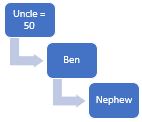
Ben is 75% of his uncle's age and 3 times older than his nephew.
If Ben's uncle is 50 years old, how old is Ben's nephew?
The correct answer is (E) – 12.5.
According to the question, Ben's uncle is 50 years old, and Ben is 75% of his age.
Ben is also 3 times older than his nephew. Therefore, Ben links the uncle's age and the nephew's age. Hence, to find the nephew's age first, you must calculate Ben's age.

What Is the CCAT Assessment Test?
The Criteria Cognitive Aptitude Test, or CCAT, is a challenging hiring assessment that evaluates both your cognitive skills and ability to stay relaxed under pressure.
It does so by employing a fast-paced battery of 50 questions to be solved in a mere 15 minutes.
What Types of Questions are on the CCAT?
According to the test's publishers, questions are grouped into abstract, verbal, and maths & logic.
On our practice course, we've divided maths and logic into two separate categories to make preparation easier. We also further divided each category into additional sub-categories.
What Types of Questions are on the CCAT?
Here are the significant employers who use CCAT for candidate assessment:
- Finastra - a financial consultancy company, uses CCAT for its recruitment process. Learn more about Finastra's CCAT.
- Vista Equity Partners - Each and every employee of Vista or any of its subsidiaries (e.g. Finastra, PowerSchool, Vertafore, etc.) is required to take the test. Visit our Vista Equity aptitude test page.
- Crossover – the Texas-based technology company is another major employer using the Criteria Cognitive Aptitude Test. Visit our Crossover aptitude test page.
- Glovo - A Food delivery app also use CCAT for employment.
- Lambda School – The online coding school use the Criteria Cognitive Aptitude Test to screen candidates for its courses.
FAQs
Most candidates find the test difficult, especially those who haven't touched high school materials in years or aren't used to solving problems under time pressure. Several types of questions, such as matrices and syllogisms, require specialised CCAT practice to become proficient.
Very few people finish all 50 questions in 15 minutes. This is why CCAT scores are not presented in raw scores (i.e. the number of correct answers) but rather in normalised percentage scores (how well you performed compared to other test-takers).
Despite the fact that few people are able to complete the Criteria Cognitive Aptitude Test in time, you should pace yourself so you can achieve the greatest number of correct answers - this will mark you as a strong candidate. Employing time-management skills and having a skipping strategy can significantly improve your score.
On the CCAT, your score is computed using the number of correct answers you successfully solve in 15 minutes. You do not lose points for getting a question wrong; you simply lose out on the points you could have gained from getting it right.
This should inform your skipping strategy. When you encounter a question you don't think you can solve fast enough, it's actually better to make an informed guess and carry on with questions you're more likely to answer correctly.
No, you are not permitted to use a calculator on the CCAT Exam. However, you are allowed a piece of draft paper and a writing utensil to jot down sketches, diagrams, or equations.
Criteria, the provider of the Criteria Cognitive Aptitude Test, is one of the world's leading test providers, with over 1500 companies in 18 countries using their assessments. From the U.S. Marine Corps to private equity companies, Criteria's pre-employment testing is used in assessing candidates to an infinite variety of employers and positions.
To learn more about Criteria Corp and prepare yourself for their assessments, visit our Criteria page. You may also want to visit Criteria's official CCAT page.
The On-Demand Assessment is Criteria's online testing platform and this is where you're going to take your CCAT Test. Most candidates receive an email invitation with a link to ondemandassessment.com.
The CCAT is a timed test which is composed of 50 questions to be answered in a 15-minute period. The test covers three main subjects: Verbal, Math and Logic, And Spatial Reasoning.
The CCAT passing score greatly depends on the position you apply to. The CCAT average score is 24 correct questions out of 50, and less than 10% of people answer more than 35 questions correctly. Answering 42 questions correctly will put you on the top scale for ANY job the CCAT tests for.
Note that while the CCAT assessment contains 50 questions, you are not expected to answer all of them.
Here are 7 expert tips to help you pass the CCAT:
- Diagnose Your Level:
Discover what type of questions you struggled with, to ensure you know what to focus on to achieve the highest score possible. - Know What to Expect on the Real CCAT:
Each and every question on our practice will resemble a question type appearing on the actual CCAT. That will allow you to know exactly what to expect and reduce test anxiety. - Learn CCAT Solving Techniques to Reduce Solving Time:
Learning and implementing techniques to solve questions faster is one of the best things you can do to increase your score. - Get Full-Length CCAT Practice Test Simulations:
Practicing full-length simulations is a critical step in practicing for any exam, and even more so on the CCAT. - Track Your Progress:
Keep track of your results, so that you change your practice focus to the most critical areas as you go. This will also allow you to know the pace of your improvement. - Master Proper Time Management:
By taking the full-length simulations, you will be able to understand how well you keep up with the required pace of the test. - Learn from Your Mistakes:
Take some time to learn your most common mistakes and what you learned from them. You'll be amazed at what an effect this process has in the long-run.


