What skills do you need to work in finance? A guide for UK graduates
▦ Published: June 3, 2026 |  6 min read
Most graduates assume finance hiring rewards the same things that got them this far - strong grades, the right university, the ability to perform under academic pressure. Those things matter, but they are not what the job itself demands on a daily basis.
This article covers the finance skills UK employers look for, what they actually look like on the job, and how to build and demonstrate each one - whether you are planning your development early or preparing to apply this cycle.
The finance skills needed for most UK graduate roles fall into three categories: technical skills (numerical reasoning, data analysis, Excel), commercial skills (market awareness, analytical thinking, financial judgement), and interpersonal skills (communication, teamwork, attention to detail). Developing all three takes deliberate effort - and the sooner you start, the more natural they feel when it matters.

Technical finance skills
Technical finance skills are the quantitative and knowledge-based capabilities that underpin most day-to-day work in financial services. They are the skills you use to build a model, interpret a dataset, follow a market, and make a defensible recommendation.
Why is numerical reasoning so central to a finance career?
Numerical reasoning is the ability to work accurately and efficiently with quantitative financial information - reading tables, interpreting ratios and percentages, and drawing correct conclusions from data. In practice, this skill runs through almost everything an analyst does: reviewing financial statements, stress-testing model assumptions, or checking whether a client's figures are internally consistent before a presentation goes out.
What this skill looks like on the job is less dramatic than people expect. It is catching a sign error in a model before it propagates through three linked sheets. It is noticing that a percentage change and an absolute figure in a client report are inconsistent with each other. It is being fast and accurate enough with numbers that colleagues trust your outputs without rechecking everything you produce.
How to show it on your CV: quantify everything. "Modelled three revenue scenarios for a £20K student fund portfolio" tells a recruiter something specific. "Strong numerical skills" tells them nothing.
Numerical reasoning isn't about being good at maths. It's about being fast, accurate, and calm with financial data under pressure - a combination built through deliberate practice.
How important is data analysis for finance graduates?
Data analysis is one of the most transferable and consistently valued skills in finance - expected at entry level and differentiating at depth. Most analytical work in banking, asset management, and financial services involves working with structured data at some stage, and the expectation from day one is that you can do so without guidance on the basics.
Data analysis in finance is about understanding what the numbers are telling you, not just producing them. A dataset is a starting point, not an answer. The analyst who looks at a revenue breakdown and identifies which segment is distorting the aggregate is adding value. The one who can only produce the table is not.
The tools vary by firm and role - Excel remains the standard across most of the industry, and Python is increasingly common in more quantitative or data-heavy functions - but the underlying skill is the same regardless of the platform: can you take a messy dataset and turn it into a clear, defensible insight?
How to develop it: practice working with real financial data. Build a simple three-statement model - profit and loss, balance sheet, cash flow - and understand how the statements connect. Companies House and the ONS publish real financial data you can work with at no cost.
How to show it on your CV: lead with what you found or decided, not what software you used. "Identified a pricing anomaly across three product lines by analysing two years of sales data, presented findings to a panel of 20 society members" is analytical thinking in action. "Proficient in Excel" is a label.
How much do you need to know about financial markets?
Financial and market knowledge refers to a working understanding of how financial products, markets, and instruments function - how equities are priced, how fixed income responds to rate changes, how a leveraged buyout is structured, and why any of it matters to clients and counterparties.
You do not need CFA-level depth as a graduate. You need enough to follow a deal announcement or a central bank decision, understand its first and second-order implications, and contribute meaningfully to a conversation about it. That is the baseline. Going deeper in one specific area - a sector, an asset class, a market dynamic - is what creates genuine credibility.
This knowledge is what allows you to ask better questions on the job. An analyst who understands why a company's debt structure matters in a rising rate environment will contribute more in a due diligence meeting than one simply executing a checklist. Market knowledge is the context that makes technical skills meaningful.
How to develop it: follow one sector or asset class properly rather than everything superficially. Read primary sources - Bank of England Monetary Policy Reports, company investor relations pages, FCA publications - rather than relying solely on news summaries. The habit is forming views, not just tracking headlines.
How to show it: in interviews, reference a specific and recent development and explain what it means - not "I follow the markets" but a clear, well-reasoned observation about a transaction, a rate decision, or a sector trend that is relevant to the firm you are speaking with.
Commercial finance skills
Commercial finance skills are the judgement-based capabilities that separate candidates who understand finance as an academic subject from those who can apply it in a professional context. These are the skills that determine whether you can read a situation, identify what matters, and make a sound recommendation - which is ultimately what finance professionals are paid to do.
What does commercial awareness actually mean in finance?
Commercial awareness is the ability to connect what is happening in markets, the economy, and the broader business environment to what it means for a specific company, client, or transaction.
In practice, commercial awareness is what allows an analyst to walk into a client meeting having already thought through how last week's rate decision affects that client's refinancing options. It is what allows a junior banker to contribute to a sector discussion rather than just take notes. It is the difference between knowing that something happened and understanding why it matters to the people in the room.
Commercial awareness is not the same as reading the news. A candidate who can summarise a market event but cannot explain its implications for a business has information without judgement. The skill is in the interpretation - taking a macro development and tracing it to a specific commercial consequence.
How to develop it: treat it as a weekly habit rather than a pre-interview sprint. One macro event, one notable deal, one sector development per week - and for each, practice articulating not just what happened but what it means and what might follow.
How to show it: in your cover letter, name a specific and recent development relevant to the bank and explain its implications. In interviews, have two or three topics you can discuss with conviction and a clear point of view - interviewers can tell a prepared opinion from a genuine one within about 30 seconds.
Commercial awareness isn't about following the news - it's about forming a view on what the news means. That judgement is what separates a candidate who sounds informed from one who actually is.
How is analytical thinking used day-to-day in finance?
Analytical thinking in finance means moving from data to a decision - not just identifying what the numbers show but understanding what they imply and what action they support. It is the skill that connects the technical work of building a model to the commercial work of advising a client.
On the job, this looks like being handed a financial dataset and being expected to produce not just a summary but a recommendation. Which of these two acquisition targets represents better value? Where is the margin pressure coming from? What is the most likely explanation for the revenue decline? Answering those questions well requires both technical competence and the ability to reason clearly under uncertainty.
The most common weakness among graduates is reporting findings rather than drawing conclusions. Presenting data is not analysis. Explaining what the data means, why it matters, and what it implies for a decision is analysis. Building this habit early - in academic work, case competitions, investment society pitches - creates a foundation that carries directly into the role.
How to show it on your CV: lead with the conclusion, not the task. "Identified two undervalued mid-cap equities using P/E comparison across sector peers, presented findings to 30 members" is analytical thinking in action. "Researched equities for investment society" is a task description.
Why does initiative matter so early in a finance career?
Initiative in finance refers to the willingness to take ownership of work, pursue understanding beyond what is required, and develop genuine views on the areas you are responsible for. Finance analysts are expected to manage their own research and analysis with limited direction from early in their careers - the role rewards intellectual curiosity and self-direction in ways that not all graduate jobs do.
This is not about working longer hours or generating more output. It is about the quality of independent thinking you bring. An analyst who reads a company's investor relations documents before a meeting out of genuine curiosity is demonstrating initiative. One who develops a view on a sector and raises it unprompted is demonstrating the kind of independent judgement that gets noticed.
How to develop it: go deep in one area rather than broad across many. Whether that is ESG disclosure frameworks, credit market dynamics, fintech regulation, or M&A activity in a specific sector - a genuine, well-grounded view on something specific is more credible than surface familiarity with everything.
How to show it: the most powerful signals of initiative on a CV are things you pursued without being asked - CFA Level 1 study, a personal investment portfolio, self-taught Python for financial data analysis. These do not need much explanation. They speak for themselves.
Interpersonal finance skills: What makes you easy to work with?
Interpersonal finance skills are the capabilities that determine how effectively you work with colleagues, clients, and senior stakeholders. They are what make or break working relationships once you are in the role - and they are assessed more directly than most graduates expect during the recruitment process.
What kind of communication skills does finance actually require?
Communication in finance means precision - the ability to explain a complex position simply, accurately, and without jargon to whoever needs to understand it. That might be a client who needs to understand the implications of a restructuring, a colleague who needs a quick verbal summary of a model output, or a managing director who wants the key point in 30 seconds flat.
This is a different standard from general articulateness. Finance communication is disciplined. The goal is not to demonstrate how much you know - it is to ensure the other person has exactly the information they need to make a decision. Unnecessary complexity is a failure mode in finance, not a signal of expertise.
Poor communication is expensive on the job. A misunderstood instruction leads to rework. An unclear client email erodes trust. A presentation that buries the key finding on slide 14 fails regardless of how good the underlying analysis is.
How to develop it: practice explaining complex things simply - to friends, in writing, in any context where you have to make something accessible to someone without your background. A useful exercise is the 30-second summary: can you explain a market event, a model output, or a deal rationale in plain language in under a minute?
How to show it: the structure and clarity of your CV and cover letter are themselves communication tests. Recruiters notice. In interviews, use the STAR framework (Situation, Task, Action, Result) as a structural guide - but deliver it as a clear narrative, not a checklist.
Why is teamwork non-negotiable in finance?
Teamwork in finance is not optional or peripheral. Most meaningful work in banking and financial services is collaborative - deals involve multiple teams, client relationships span multiple touchpoints, and the complexity of most work exceeds what any individual can manage alone.
At the graduate level, this means contributing effectively to a team without needing to lead it, supporting colleagues when capacity is stretched, and disagreeing constructively without damaging the working relationship. The analyst who produces strong individual work but creates friction in the team is a net cost, not a net benefit.
Adaptability is closely related. Finance moves quickly and priorities shift - a deal falls through, a client changes requirements, a market moves unexpectedly. The ability to adjust without losing composure is noticed and valued from early in a career.
How to develop it: in any group context - academic projects, society committees, part-time work - consciously practise the supporting and facilitating role, not just the lead. The skill of helping a group reach a better outcome than it would have without you is distinct from, and often more valuable than, the skill of directing it.
How to show it on your CV: separate your contribution from the team's result. "I developed the financial projections and sensitivity analysis that underpinned the team's recommendation" is specific and attributable. "We delivered a market entry strategy" tells a recruiter nothing about your individual role.
Is attention to detail really that important in finance
Attention to detail is a genuine and consequential skill in finance - not a filler answer for competency interviews. In a financial model, one incorrect formula that propagates through 40 linked cells can produce a materially wrong recommendation. In a client document, an inconsistency between a figure in the text and a figure in the appendix undermines the credibility of everything around it.
The professional standard in finance is that your outputs are trusted. Colleagues and clients rely on the numbers you produce without independently verifying every figure. That trust is built through consistent accuracy over time - and lost quickly through careless errors.
This is a habit, not a talent. The analysts known for accurate work are not necessarily more intelligent than those who make errors - they have built reliable checking processes and apply them consistently, even under pressure, even at the end of a long day.
How to develop it: build a two-pass review habit for everything you produce. One pass for content - does this say what it needs to say? One pass for errors - is every number, reference, and formatting element correct? Apply this to academic work, applications, and your CV.
Attention to detail in finance isn't about being a perfectionist. It's about being someone whose work can be trusted without verification - a reputation that takes time to build and very little time to lose.
How do you show finance skills on your CV?
The most common mistake on a finance graduate CV is listing skills as labels without evidence. "Strong communicator," "commercially aware," "detail-oriented" - these phrases appear on the majority of graduate applications and, without proof behind them, give a recruiter nothing to differentiate you.
Every skill claim needs a one-line proof. What did you do, with what information, in what context, and with what result? This is the logic of the CAR framework - Context, Action, Result - applied at the level of a single bullet point.
The difference in practice:
Before: "Strong Excel and data analysis skills"
After: "Built a three-scenario revenue model in Excel to evaluate two acquisition targets for a university investment society pitch, presented to a panel of 15 members"
The second version is specific and attributable. The first tells a recruiter nothing beyond the fact that you believe you have the skill.
Language matters too. Applicant tracking systems scan for specific terms before a human reviews the document. Where it is accurate to do so, mirror the language used in the job description. According to Prospects.ac.uk, finance employers consistently look for evidence of quantitative ability, commercial context, and specific outcomes - not general claims.
Your CV structure is itself a skills signal. Consistent formatting, clear layout, and the absence of errors communicate something about your attention to detail and communication discipline before a recruiter has read a word of the content. You can use JobTestPrep's AI CV Analyzer to help you!
Proving your skills in the recruitment process
Understanding what finance skills are and being able to demonstrate them under pressure are two different things. Once you have started building the skills covered in this article, the next step is understanding how they are assessed - because the format matters as much as the substance.
Most UK graduate banking recruiters test these skills formally before you reach a human interviewer. Numerical reasoning, logical thinking, and commercial judgement are assessed through psychometric tests and situational judgement tests at the online stage. Communication and teamwork are evaluated at assessment centres. Each test format is specific - and candidates who practise in a realistic, bank-specific environment consistently perform better than those who encounter the format for the first time on the day.
If you want to understand exactly how each of these skills is tested - and practise in the format used by Goldman Sachs, JP Morgan, Barclays, and other major UK employers - JobTestPrep's bank-specific PrepPacks are designed for that purpose.
Building your finance skills
Technical, commercial, and interpersonal skills all matter in a finance career, and all three need to be developed before you can demonstrate them convincingly. No single skill carries an application on its own, and a genuine gap in any category shows - in interviews, in assessment centres, and on the job.
The real differentiator between candidates who progress and those who do not is rarely raw ability. It is knowing what each skill looks like in practice, and having put in the deliberate work to develop it. That work is finite, achievable, and worth starting well before application season arrives.
Banking Summer Internship Tests PrepPack
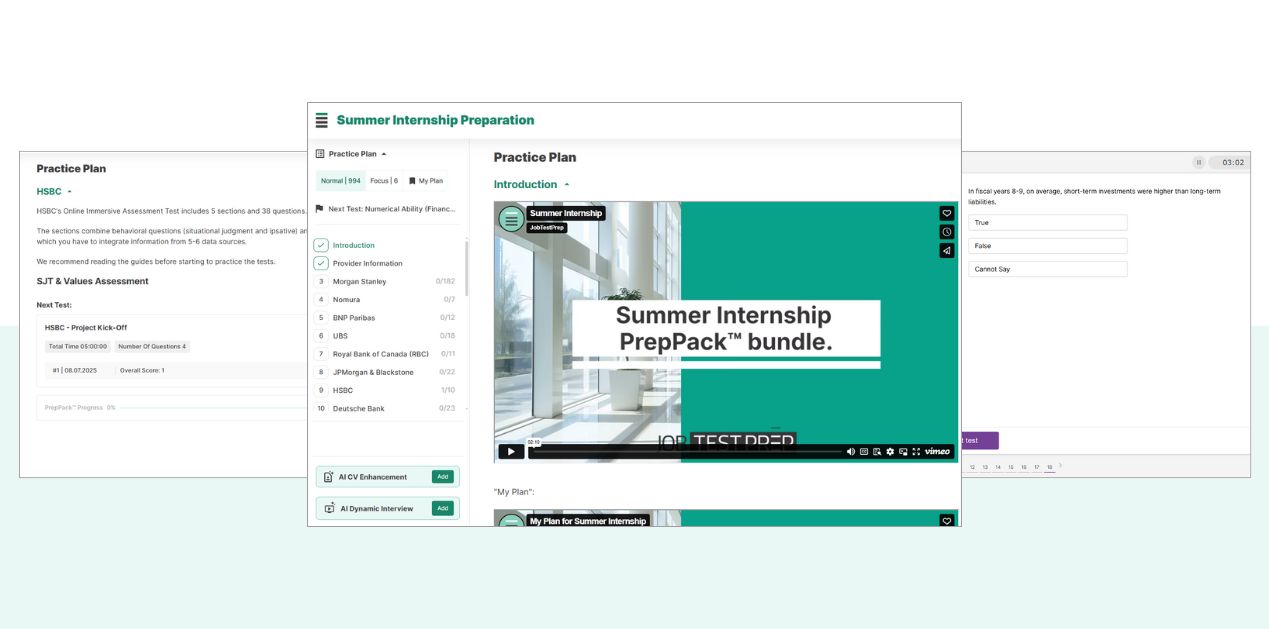
Explore our comprehensive, up-to-date preparation pack tailored to equip you for success in numerous leading banks and investment firms!
Related articles:

Top Finance Summer Internships to Apply for

How To Prepare for Landing a Top Finance Internship

Mastering Interviews: In-Person, Video, & AI Strategies