Big Five Personality Test Score Interpretation: What Your Results Mean for Your Career Role
Published: 11th February 2026 | 8 min read
Your Big Five personality test scores aren't just about self-knowledge- they're powerful career insights. Whether you've just completed a personality assessment or you're exploring career options, understanding how to interpret your Big Five scores in the context of specific roles can be transformative for your professional life.
The Big Five test measures five core dimensions that influence how we work and thrive in different environments. But here's what most people miss: the same personality profile that makes someone exceptional in sales might create struggles in finance, and vice versa. There's no "bad" score - only better or worse fits for specific career paths.

Understanding Big Five Scoring Basics
The Big Five assessment measures you on five independent traits, remembered by the acronym OCEAN
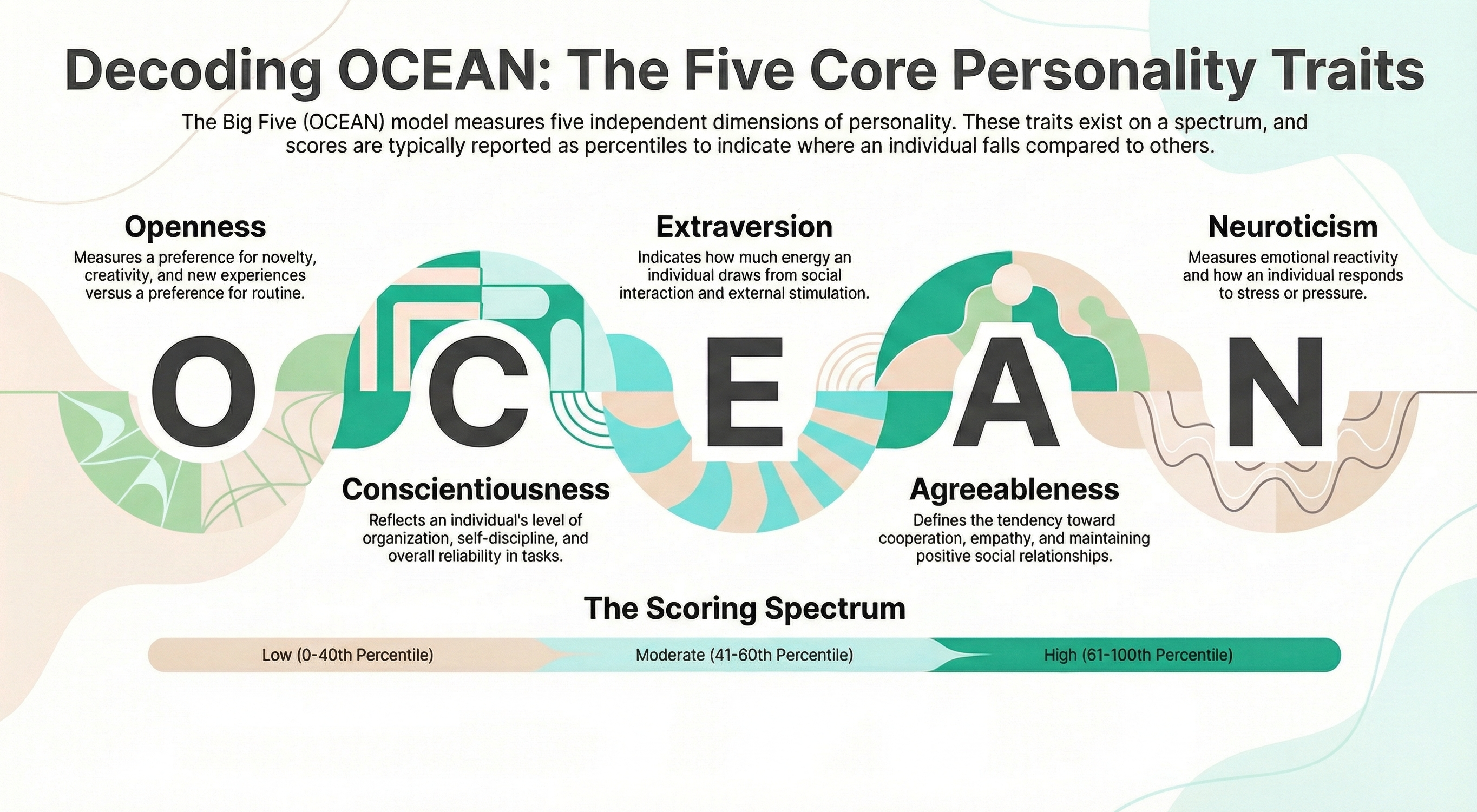
Understanding big five scoring is crucial because different roles benefit from different trait combinations. A score that's "low" isn't a weakness -it simply indicates where you fall on a spectrum, and every point has advantages in the right context.
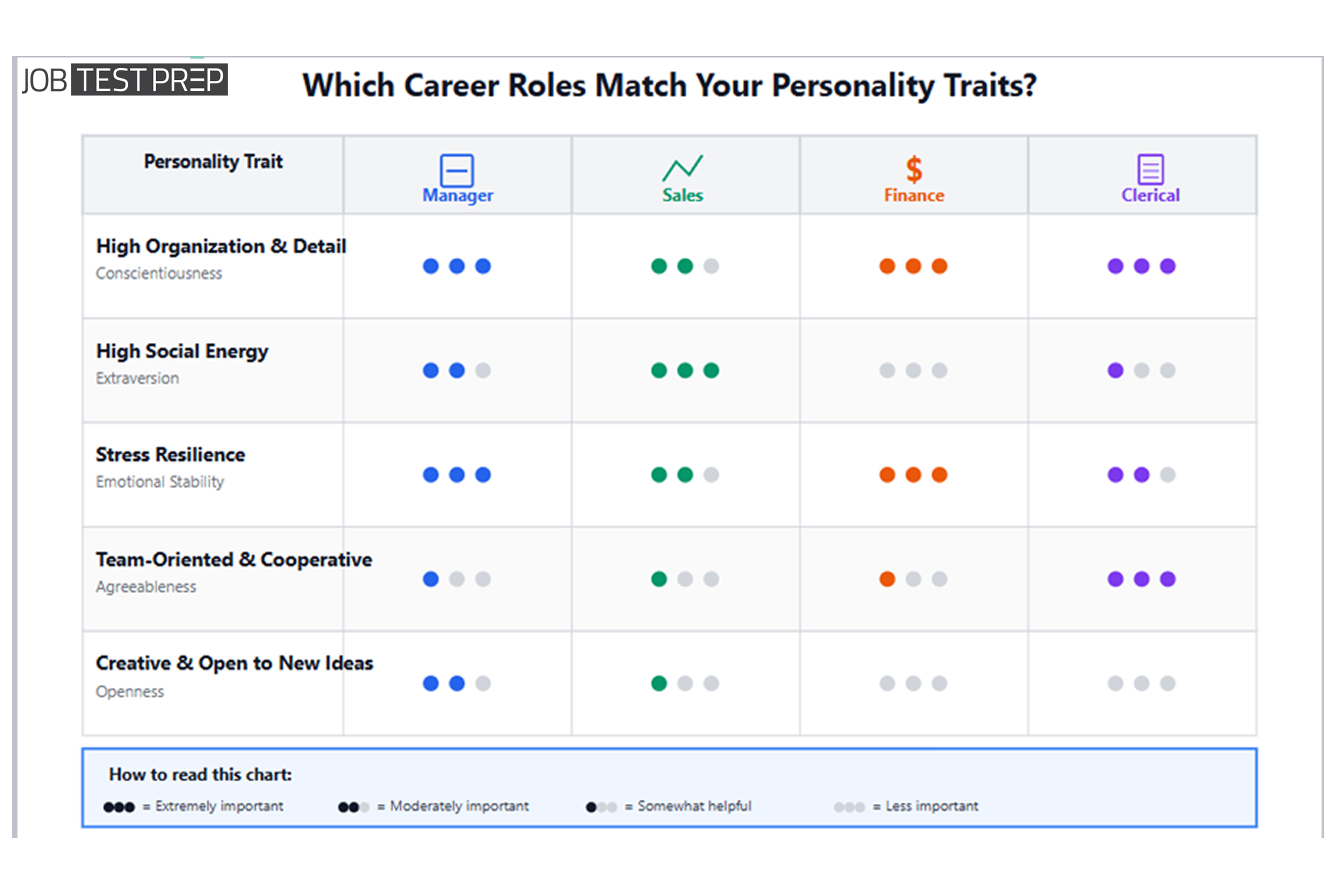
Which Career Roles Match Your Personality Traits?
This chart shows which personality traits are most important for each career role. The more circles filled, the more important that trait is for success.

Quick Reference: Top Traits by Career Role
👔 Manager
- ✓ High Conscientiousness (organized, reliable)
- ✓ High Emotional Stability (handles pressure)
- ✓ Moderate-High Extraversion (team leadership)
📈 Sales
- ✓ High Extraversion (social energy, networking)
- ✓ Moderate-High Conscientiousness (follow-up)
- ✓ High Emotional Stability (handles rejection)
💰 Finance
- ✓ Very High Conscientiousness (detail-focused)
- ✓ High Emotional Stability (deadline pressure)
- ✓ Lower Openness (values routine, procedures)
📄 Clerical
- ✓ High Conscientiousness (organized, accurate)
- ✓ High Agreeableness (supportive, helpful)
- ✓ Moderate Extraversion (balanced interaction)
Big Five Personality Test Score Interpretation for Managers
Management roles require a unique balance of personality traits. Successful managers typically combine strong organizational skills with the ability to lead teams and handle pressure. While no single personality profile guarantees management success, certain trait combinations predict higher performance and job satisfaction in leadership positions.
Ideal Score Patterns for Management Roles
Conscientiousness (High: 65-85th percentile)
Organization and reliability define effective managers. High conscientiousness translates to project completion, team accountability, and strategic planning. You naturally follow through on commitments and drive results even when obstacles arise.
Why it matters: Teams need leaders who meet deadlines, coordinate complex initiatives, and hold everyone accountable to objectives.
Extraversion (Moderate-High: 55-75th percentile)
This range provides energy for team motivation and presentations while preserving capacity for focused strategy work. You can inspire teams, lead meetings effectively, and network with other departments without burning out from constant interaction.
Why it matters: Leadership requires inspiring teams and stakeholder engagement, but also demands time for planning and decision-making that benefits from quieter reflection.
Emotional Stability (High: 65-85th percentile)
Stress resilience separates good managers from great ones. You remain calm under pressure, make clear decisions during crises, and provide stability for your team when challenges arise.
Why it matters: Managers face constant pressure from all directions. Your ability to handle conflict, manage change, and maintain composure directly impacts team morale and performance.
Openness (Moderate-High: 50-70th percentile)
Innovation balanced with practicality characterizes effective leadership. This range suggests you're open to new ideas and strategic thinking while remaining grounded enough to implement realistic solutions.
Agreeableness (Moderate: 45-65th percentile)
The sweet spot lies in balanced empathy and assertiveness. This moderate range enables building relationships while making necessary difficult calls like performance reviews and resource negotiations.
Understanding Your Personality Fit for Management
Your Big Five scores help predict natural tendencies, but they're not make-or-break in hiring. Hiring managers typically use personality assessments to guide interview questions and understand where you'll need support.
If you have lower Conscientiousness:
- What this signals: You may struggle with follow-through, tracking details, and maintaining organizational systems without external structure.
- Interview focus: Expect questions about how you track projects, meet deadlines, and ensure nothing falls through the cracks.
- Path forward: Build strong systems (project management tools, executive assistants, structured processes) or consider roles emphasizing vision over execution (early-stage startups, strategy positions).
If you have lower Extraversion:
- What this signals: You may find frequent team interactions, presentations, and networking draining rather than energizing.
- Interview focus: Questions about your communication style, team motivation approach, and how you recharge.
- Path forward: This can actually be a strength—pursue management of technical teams, remote teams, or roles emphasizing written communication and one-on-one relationships.
If you have higher Agreeableness:
- What this signals: You may struggle with difficult conversations, saying no, and making unpopular decisions that hurt relationships.
- Interview focus: Expect scenarios about delivering critical feedback, handling underperformers, and making tough resource decisions.
- Path forward: Develop skills in direct communication and boundary-setting, or pursue collaborative leadership roles where consensus-building is valued (project management, cross-functional leadership).
Big Five Scoring for Sales Professionals
Sales is one of the most personality-driven careers. Your Big Five profile strongly predicts not just whether you'll succeed in sales, but which type of sales role will energize you versus drain you. Understanding your personality pattern helps you target the right sales specialization and set realistic performance expectations.

Optimal Trait Combinations for Sales Success
Extraversion (High: 70-90th percentile)
Sales runs on social energy. High extraversion fuels cold calling, networking, and relationship building—activities that energize rather than drain you. You thrive in high-interaction environments and find joy in activities that exhaust others.
Why it matters: Successful sales requires consistent prospecting, building rapport quickly, energizing presentations, and maintaining enthusiasm through long sales cycles.
Conscientiousness (Moderate-High: 60-80th percentile)
While personality drives connections, conscientiousness drives revenue. You follow through on leads, manage pipelines systematically, and meet quotas through disciplined follow-up and CRM hygiene.
Why it matters: The difference between good and great salespeople often comes down to persistent pursuit of opportunities until they close.
Agreeableness (Moderate: 45-65th percentile)
Building trust without being pushy requires this balanced range. You're likable and empathetic enough to build genuine relationships, but assertive enough to ask for the sale and negotiate effectively.
Why it matters: Consultative selling requires understanding client needs deeply while also guiding them toward decisions and maintaining healthy boundaries.
Emotional Stability (Moderate-High: 60-80th percentile)
Sales involves rejection. Emotional stability determines whether you bounce back from "no," maintain motivation through slumps, and bring fresh energy to each prospect. Even exceptional salespeople hear "no" far more often than "yes."
Openness (Moderate: 40-60th percentile)
You can customize approaches, understand different perspectives, and solve problems creatively while maintaining a consistent, proven sales process.
Understanding Your Personality Fit for Sales
Sales hiring managers use Big Five scores to predict performance patterns. Certain trait combinations genuinely make sales harder, though not impossible with the right role match.
If you have lower Extraversion:
- What this signals: Prospecting, cold calling, and high-volume social interaction will drain your energy quickly.
- Interview focus: Questions about your networking approach, how you build pipeline, and your ideal client interaction style.
- Path forward: Target inside sales, technical sales, account management, or consultative roles with longer sales cycles and deeper relationships rather than high-volume transactional sales.
If you have higher Agreeableness:
- What this signals: You may avoid asking for the sale, struggle with negotiation, and have difficulty handling pushy buyers or walking away from bad deals.
- Interview focus: Role-play scenarios involving price negotiation, handling objections, and pushing back on unreasonable client demands.
- Path forward: This is a legitimate challenge in competitive sales. Consider customer success, account management, partnership roles, or sales in relationship-driven industries (healthcare, education, non-profit) where trust matters more than assertiveness.
If you have lower Conscientiousness:
- What this signals: You may struggle with CRM hygiene, consistent follow-up, pipeline management, and administrative tasks that drive revenue.
- Interview focus: Questions about your organization systems, how you track opportunities, and examples of long-term follow-through.
- Path forward: Pursue transactional sales with short cycles, or ensure you have strong sales operations support. Your spontaneity can be an asset in relationship-based selling if paired with good systems.
Personality Test Scoring Interpretation for Finance Roles
Finance and accounting demand specific personality profiles more than most careers. The nature of the work—detail-intensive, deadline-driven, and high-stakes—means certain Big Five patterns strongly predict both performance and job satisfaction. Understanding how your scores align with finance requirements helps you choose the right specialization or recognize when alternative career paths might better suit your natural strengths.

Key Traits for Finance and Accounting Positions
Conscientiousness (High: 75-95th percentile)
Finance demands exceptional detail orientation and accuracy. Very high conscientiousness means you catch errors, follow procedures meticulously, and maintain the precision financial reporting requires. A single misplaced decimal can have significant consequences.
Why it matters: Financial reporting, compliance, audit preparation, and data accuracy all depend on extreme attention to detail. You excel at month-end close, reconciliations, and error-free statements.
Emotional Stability (High: 70-90th percentile)
Month-end closes, audits, and executive reporting create intense pressure. You remain calm under scrutiny, think clearly under tight deadlines, and maintain accuracy when stressed.
Why it matters: Your ability to perform accurately under regulatory reviews and high-pressure deadlines is essential.
Openness (Low-Moderate: 30-55th percentile)
Finance values consistency and established procedures. Lower openness indicates comfort with routine, preference for standardized processes, and respect for regulatory frameworks like GAAP. You find satisfaction in applying reliable processes and maintaining internal controls.
Agreeableness (Moderate: 45-60th percentile)
Finance professionals must collaborate across departments while maintaining independence. Moderate agreeableness provides the balance; friendly enough to partner effectively, assertive enough to challenge when numbers don't add up.
Extraversion (Low-Moderate: 30-55th percentile)
Much finance work requires deep concentration and independent analysis. You draw energy from focused, analytical work and thrive during solo analysis and detailed review without needing constant social interaction.
Understanding Your Personality Fit for Finance
Finance roles have stricter personality requirements than most fields due to regulatory and accuracy demands. Scores outside typical ranges warrant honest assessment.
If you have lower Conscientiousness:
- What this signals: You're at higher risk for errors, missed deadlines, and compliance issues—serious concerns in finance.
- Interview focus: Expect detailed questions about your quality control processes, how you catch errors, and examples of sustained accuracy.
- Path forward: Traditional accounting and audit roles will be challenging. Consider FP&A, strategic finance, or finance roles in fast-paced startups where speed matters more than precision, but acknowledge this is a genuine limitation.
If you have higher Openness:
- What this signals: You may find routine financial tasks boring and struggle with the repetitive nature of monthly closes and standardized procedures.
- Interview focus: Questions about your comfort with routine, how you stay engaged with repetitive tasks, and your approach to established procedures.
- Path forward: This is actually fine—target FP&A, corporate strategy, investor relations, or finance transformation roles that emphasize analysis and innovation over routine reporting.
If you have higher Extraversion:
- What this signals: You may find the independent, desk-focused nature of finance work unfulfilling and seek more interaction than the role provides.
- Interview focus: Questions about your ideal work environment, how you stay motivated during solo work, and your collaboration style.
- Path forward: Look for finance business partner roles, investor relations, corporate development, or positions requiring frequent cross-functional collaboration rather than traditional accounting.
Big Five Score Interpretation for Clerical and Administrative Roles
Administrative and clerical positions are the organizational backbone of most companies. While often undervalued, these roles require a specific personality profile to excel. The combination of detail management, interpersonal support, and adaptability to changing priorities means certain Big Five patterns predict significantly higher job performance and satisfaction in administrative work.
Administrative Success Personality Patterns
Conscientiousness (High: 70-90th percentile)
Administrative excellence depends on organization and reliability. You naturally maintain orderly systems, meet deadlines consistently, and ensure nothing falls through the cracks. You coordinate complex schedules flawlessly and catch errors before they become problems.
Why it matters: Calendar management, document accuracy, deadline juggling, and process adherence all depend on your ability to stay organized under varying demands.
Agreeableness (Moderate-High: 55-75th percentile)
Administrative roles are fundamentally supportive. Higher agreeableness translates to cooperation, helpfulness, and maintaining positive relationships across the organization. You genuinely enjoy helping colleagues succeed.
Why it matters: You're supporting executives, teams, or entire departments - success requires a service mindset, patience, and skill at being an interdepartmental liaison.
Emotional Stability (Moderate-High: 60-80th percentile)
Administrative work involves rapidly changing priorities and last-minute requests. You stay steady through unpredictability, handle urgent requests calmly, and maintain professionalism when facing conflicting demands.
Extraversion (Moderate: 40-60th percentile)
The ideal balance: enough extraversion for phones, front-desk duties, and professional communication, but also the ability to focus on independent tasks like data entry and document preparation.
Openness (Low-Moderate: 35-55th percentile)
Administrative roles typically involve established workflows and standard operating procedures. Comfort with routine (lower openness) often indicates strong fit. You find satisfaction in perfecting processes and reliable execution.
Understanding Your Personality Fit for Administrative Roles
Administrative hiring managers look for reliability and interpersonal skills. Certain personality patterns predict higher success and job satisfaction.
If you have lower Conscientiousness:
- What this signals: You may struggle with the organizational demands, attention to detail, and reliability that are core to administrative work.
- Interview focus: Expect questions about your organizational systems, how you handle multiple priorities, and examples of maintaining accuracy under pressure.
- Path forward: Traditional administrative roles will be challenging. Consider coordinator roles in creative environments, event planning, or positions emphasizing people skills over process management.
If you have higher Openness:
- What this signals: You may find routine administrative tasks unstimulating and seek more variety than typical clerical roles provide.
- Interview focus: Questions about your comfort with repetitive tasks, how you stay engaged, and what motivates you day-to-day.
- Path forward: This creates genuine fit challenges. Look for administrative roles in dynamic environments (startups, agencies), project coordination, or executive assistant roles supporting leaders in fast-changing industries.
If you have lower Agreeableness:
- What this signals: You may struggle with the service-oriented, supportive nature of administrative work and find constant accommodation frustrating.
- Interview focus: Scenarios about handling difficult requests, supporting others' priorities, and maintaining patience with demanding stakeholders.
- Path forward: Consider operations coordinator, project administrator, or technical administration roles that emphasize systems and processes over interpersonal support.
Remember: These assessments aren't pass/fail. Hiring managers use them to guide interview questions, understand where you'll need support, and assess overall fit with team dynamics and role demands.
How to Use Your Big Five Personality Test Score Interpretation for Career Planning
Step 1: Compare Your Scores
Look at the chart above. Which role profile most closely matches your pattern? You don't need perfect alignment—look for 3-4 traits that align well.
Step 2: Identify Strongest Alignments
Focus on where your personality naturally fits. High conscientiousness and emotional stability? Finance and admin leverage these strengths. High extraversion? Sales and certain management roles will energize you.
Step 3: No Perfect Match? Consider Specializations
Within each career category, numerous specializations exist. A sales professional with moderate extraversion can succeed in technical or inside sales. A higher-openness finance person might thrive in FP&A rather than audit.
Step 4: Build Complementary Skills
Where you don't naturally align, develop compensating strategies. Lower conscientiousness? Implement rigorous systems and tools. Lower emotional stability? Build stress management practices. Self-awareness plus intentional development creates success.
Practical Applications
Use your big five personality test score interpretation for:
- In-role performance: Work with your personality rather than against it
- Career exploration: Evaluate new roles through the lens of personality fit
- Job interviews: Discuss how your personality strengths align with role requirements
- Development conversations: Share results with managers to create targeted development plans
- Job selection: When choosing between offers, consider which role better matches your profile
Important Reminders
Personality is one factor among many in career success. Skills, experience, values, interests, education, and opportunity all matter tremendously. Use these insights as guidance, not rigid requirements.
Success is possible in any role with sufficient self-awareness, adaptation, and support systems. Many highly successful professionals fall outside "ideal" ranges but compensate through other strengths and deliberate skill development.
Conclusion
Your Big Five scores provide a career roadmap, not a limitation. Understanding big five scoring and interpretation helps you identify roles where your natural tendencies become advantages rather than obstacles.
The profiles above show tendencies—many successful professionals fall outside these ranges and thrive through self-awareness, skill development, and finding the right niche within their field. The goal isn't to perfectly match a profile but to understand where you'll work with your nature rather than constantly fighting against it.
Best-fit roles leverage your natural strengths and minimize the energy drain of constantly acting against your personality. Even "mismatched" scores can lead to success when you build awareness, strategy, and appropriate support systems.
Take time to review your scores through the lens of your current or desired role. Where do you align well? Where might you need to build compensating strategies? Consider discussing your results with a mentor, manager, or career counselor for additional perspective.
Your next step: Identify one way to leverage your strongest personality trait in your work this week. Whether that's using your high conscientiousness to improve a process, your extraversion to build a key relationship, or your emotional stability to handle a challenging situation—put your personality to work for you.
Understanding your big five personality test score interpretation isn't about changing who you are—it's about finding where you naturally excel and building a career that works with your personality, not against it.