A Guide to Time Management
Published: December 8, 2025 | 6 min read
Many cognitive ability tests are not just about what you know, but how well you manage your time under pressure. Even if you’ve mastered the material, poor pacing can lower your score.
This guide will train you to approach questions strategically, prioritize effectively, and stay calm under time limits.
You’ll learn:
- Macro strategies – managing time across the entire test.
- Micro strategies – managing time on individual questions.
- Application practice – applying both levels under realistic conditions.
Section 1: Macro-Level Time Management
Consider the entire test:
Know the total time and break it into chunks, and practice under the same time constraints. Example: If your test has 50 questions in 15 minutes, that’s 18 seconds per question. Some will take only 5 seconds, others 30 seconds, but knowing the average helps you pace yourself. If you practice with this timing before test day, the pressure will feel much more natural
Balance easy vs. hard questions
As you practice, notice which topics are easier for you and which take longer. Move quickly through the easy questions so you have more time for the harder ones. Example: If you finish a simple question in 5 seconds, you’ve earned extra time for a harder one later. Use this to your advantage
Keep an eye on the clock - but don’t let it overwhelm you:
Example: Glancing at the clock every 2–3 questions are helpful. Watching it constantly just adds pressure and wastes focus.
If stuck, make an educated guess and move on:
Example: Say a question is eating up more than 30 seconds. Instead of losing time, make your best guess, mark it if the test allows, and continue to collect points from easier questions.
Practice Question
You have 40 questions to solve in 20 minutes. After 5 minutes, you notice you’ve only answered
5 questions. What should you do?
Explanation: At 5 questions in 5 minutes, you’re pacing for 20 total - half of what’s required. The best adjustment is to pick up speed by tackling the easier, faster questions first.
Practice Question 2 (Multiple Choice)
In the test you’re preparing for, you’ll need to answer 50 questions in 10 minutes. You decide to practice under the same time conditions while balancing easy vs hard questions. What does this mean?
Explanation: Practicing under test time constraints means being aware of how much time you have for each question or section and learning to manage it wisely. While it’s helpful to know the average time per question, it’s not necessary to follow it strictly. Instead, recognize which questions are easier and which are harder for you, and allocate your time accordingly - spending less time on the easy ones and more on those that require extra thought.
Section 2: Micro-Level Time Management
When managing time on individual questions, small habits can save precious seconds:
Process of elimination
Instead of searching for the right answer, rule out wrong ones first. Example: If a question asks for a sound an animal makes and one option is “RUN,” you can eliminate it immediately - it’s not a sound.
Mental shortcuts (approximation, estimation, patterns)
Not every problem needs full calculation, which can be time consuming. Example: If something costs $100 and is 25% off, you don’t need long math - 25% of 100 is 25, so the new price is $75.
Draw or jot notes (when allowed)
Offload details onto paper instead of keeping everything in your head. Example: In a seating arrangement puzzle, make a quick sketch of where each person sits instead of keeping it all in your head.
Predict the answer first
Think of a likely word or number before checking the options. Example: In “She answered the question in a ______ manner,” you might predict “confident.” Then, you can quickly confirm the right option.
Mental Shortcuts - Numerical Example
Question
A coat usually costs $60. It’s on sale for 30% off. What is the new price?
Hint: Approximate first. For example, 50% off $60 would be $30. Since 30% off is less than half off, the answer must be between $30 and $60.
Elimination - Verbal Example
Question
Question:
WOLF is to HOWL as…
Hint: Use elimination. For example, “CAT is to PURR” works because PURR is a sound. Cross out
any options where the second word isn’t a sound.
Draw or jot notes - Logic Example
Question
Question:
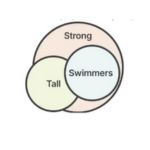
Assume the first two statements are true. Is the last statement true, false, or uncertain?
1. All swimmers are strong.
2. Some strong people are also tall.
3. Some swimmers are tall.
Hint: Draw a quick diagram. For example, sketch three circles for “Swimmers,” “Strong,” and
“Tall.” This makes overlaps easier to test than holding it in your head.
Correct Answer: C (Uncertain)
Explanation: In one diagram tall overlaps swimmers (true). In another tall overlaps strong but
not swimmers (false). Since both are possible, the correct answer is uncertain.
Predict the answer first - Sentence Completion Example
Question
Question:
Despite his nervousness, Daniel delivered his speech in a __________ manner that impressed
the audience.
Hint: Predict first. For example, in “She walked into the room with a __________ smile,” you
might predict “warm.” Doing this helps you spot the right choice faster.
Section 3: Application Challenge
Scenario:
You are taking a 30-question test with a 15-minute limit. After 8 minutes, you’ve answered 10 questions. You face a difficult one that’s taking longer than expected.
What should you do?
Section 4: Self-Check
Am I aware of how much time I have per question?
Did I skip or guess strategically instead of getting stuck?
Did I use elimination and mental shortcuts?
Did I avoid double-checking too much under time pressure?
Summary
Macro level: Balance time across the test; don’t get stuck.
Micro level: Use elimination, shortcuts, diagrams, and predictions.
Application: Practice under real timing so these strategies become automatic.
Mastering time management not only raises your score—it reduces stress and builds confidence
on test day.